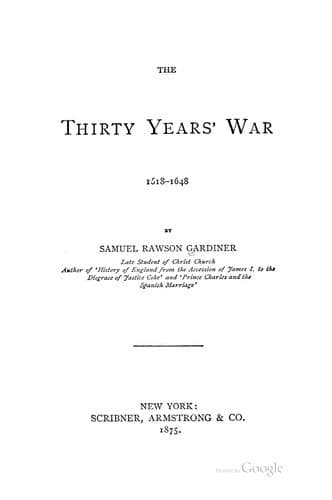
The Thirty Years' War, 1618-1648Gardiner, Samuel Rawson
History
The Thirty Years' War, 1618-1648
Gardiner, Samuel Rawson
Thirty Years' War, 1618-1648
Wallenstein's failure was an event of incalculable importance in the
history of Germany. It was much that one, and that not one of the first,
towns of the Empire should have beaten back the tide of conquest. But it
was more that the resistance should have been attempted in a case which
sooner or later would be the cause of the great majority of Germans.
Ferdinand had floated to power because he personified order as opposed
to anarchy. The Stralsunders fought for the Protestant religion and
freedom from the presence of a garrison. Ferdinand's order meant the
rule of the priest, and the rule of the soldiers. Slowly and unwillingly
the citizens of Stralsund declared for the presence of foreigners as
better than such order as this.
SECTION IV.--_The Siege of Rochelle._
[Sidenote: § 1. Stralsund and Rochelle.]
The tide was on the turn in Germany. But the tide was not on the turn in
France. There, too, a maritime city, greater and wealthier than
Stralsund, and supported by fleets and armies from beyond the sea, was
defending the cause of Protestantism against the central government.
Mainly because in France the central government represented something
more than the rule of the priest and the soldier, the resistance which
was successful in Germany was overpowered in France.
[Sidenote: 1625.
§ 2. England and France.]
During the year 1625 the coolness between England and France had been on
the increase. The persecution of the English Catholics by Charles, in
contravention of his promises, had greatly exasperated Lewis, and the
seizure by the English cruisers of numerous French vessels charged with
carrying on a contraband traffic with the Spanish Netherlands had not
contributed to calm his indignation. Charles, on the other hand,
regarded himself as the natural protector of the French Protestants, and
made demands in their favour which only served to make Lewis more
resolved to refuse every concession.
[Sidenote: § 3. Richelieu would have made peace with the Huguenots if he
could.]
Public-domain text, read in full here on John Shaqi.
Reviews
Reviews
No reviews yet
Be the first to share your thoughts on this work.
Elsewhere in the archive
Join the Discussion
Join the discussion
Sign in to leave a comment or review.
Sign InorCreate an account