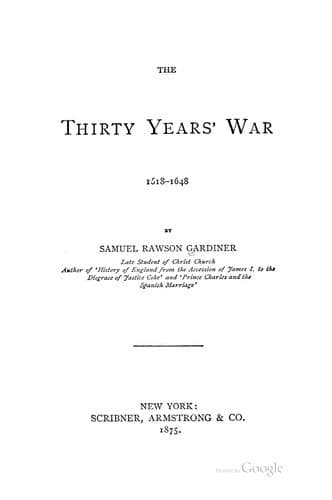
The Thirty Years' War, 1618-1648Gardiner, Samuel Rawson
History
The Thirty Years' War, 1618-1648
Gardiner, Samuel Rawson
Thirty Years' War, 1618-1648
Fort Louis, therefore, was not demolished. A peace was patched up
between France and Spain. Charles grew more and more angry with Lewis
for deserting the common cause. Fresh seizures of French ships by
English cruisers came to exasperate the quarrel, and in the early months
of 1627 war existed between the two nations, in reality if not in name.
In July a great English fleet, with a land army on board, appeared off
Rochelle, under the command of Charles' favourite, Buckingham. A
landing was effected on the Isle of Rhé, and siege was laid to the
principal fort of the island. At last the garrison was almost starved
out, and the commander offered to come the next morning into the English
quarters to treat for terms of surrender. That night a stiff easterly
breeze sprung up, and a French flotilla, heavily laden with provisions,
put off from the main land. Some of the boats were taken, but most of
them made their way safely through the English guardships, and delivered
their precious store under the guns of the fort. Buckingham lingered for
some weeks longer. Every day the besiegers swept the horizon in vain
with their glasses, looking for succour from England. But Charles,
without parliamentary support, was too poor to send off succours
hurriedly, and when they were at last ready a long continuance of
westerly winds prevented them from leaving the Channel. Before they
could put to sea, a French force was landed on the island, and
Buckingham, to save himself from defeat, was forced to break up the
siege and to return home discomfited.
[Sidenote: § 8. Siege of Rochelle.]
Richelieu and the king were now thoroughly of one mind. The French city
which could enter into an understanding with the foreigner must be
reduced to submission. An army of thirty thousand men gathered round the
walls, and on the land side the town was as hopelessly blocked up as
Stralsund. The only question was whether it would be possible to cut off
the entrance of English supplies by sea. By the end of November a
commencement was made of the mole which was to shut off Rochelle from
all external help. Piles were driven in with stones between them.
Heavily laden vessels were scuttled and sunk. Richelieu himself directed
the operations, this time with the full support of the clergy, who
poured their money lavishly into the royal treasury. In May, 1628, the
work, in spite of the storms of winter, was almost completed. An English
fleet, which came up to the succour of the town, retired without
accomplishing anything.
[Sidenote: § 9. Increasing despondency in the town.]
Inside the town distress was rapidly growing unendurable. The mayor,
Jean Guiton, was still the soul of the resistance. But he had to
struggle against an increasing number who counselled surrender. He did
not venture to appear in the streets without a pistol in his hand and
half-a-dozen stout guardians around him.
[Sidenote: § 10. Failure of the English attempt to succour it.]
Public-domain text, read in full here on John Shaqi.
Reviews
Reviews
No reviews yet
Be the first to share your thoughts on this work.
Elsewhere in the archive
Join the Discussion
Join the discussion
Sign in to leave a comment or review.
Sign InorCreate an account