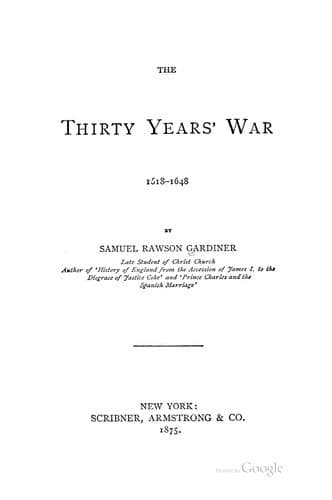
The Thirty Years' War, 1618-1648Gardiner, Samuel Rawson
History
The Thirty Years' War, 1618-1648
Gardiner, Samuel Rawson
Thirty Years' War, 1618-1648
When Lewis appeared within the walls of Rochelle he cancelled the
privileges of the town, ordered its walls to be pulled down and its
churches to be given over to the Catholic worship. But under Richelieu's
guidance he announced his resolution to assure the Protestants a
continuance of the religious liberties granted by his father. No towns
in France should be garrisoned by troops other than the king's. No
authorities in France should give orders independently of the king. But
wherever a religion which was not that of the king had succeeded in
establishing its power over men's minds no attempt should be made to
effect a change by force. Armed with such a principle as this, France
would soon be far stronger than her neighbours. If Catholic and Huguenot
could come to regard one another as Frenchmen and nothing else, what
chance had foreign powers of resisting her? She had already beaten back
the attack of a divided England. Would she not soon acquire a
preponderance over a divided Germany? It is time for us now to ask what
steps were being taken in Germany to meet or to increase the danger.
CHAPTER VII.
THE EDICT OF RESTITUTION.
SECTION I.--_Oppression of the Protestants._
[Sidenote: 1628.
§ 1. Siege of Glückstadt.]
It was not at Stralsund only that Wallenstein learned that he could be
successfully resisted. Stade had surrendered with its English garrison
to Tilly in April, but Glückstadt still held out. In vain Wallenstein
came in person to Tilly's aid. The Danish cruisers kept the sea open.
Wallenstein was obliged to retire. In January, 1629, the works of the
besiegers were destroyed by a sally of the garrison.
[Sidenote: 1629.
§ 2. The Peace of Lübeck.]
Wallenstein, the great calculator, saw that peace with Denmark was
necessary. The Swedes and the Danes were beginning to act together, and
resistance to one nation, if there must be resistance, would be easier
than resistance to two. Much to his satisfaction he found Christian not
unwilling to listen to the voice of his charming. Just as the eagle eye
of Gustavus descried the first feeble beams of light on the horizon,
the King of Denmark, weary of misfortune and vexed at the prospect of
having to crave help from his old competitor of Sweden, laid down his
arms. On May 22, 1629, a treaty of peace was signed at Lübeck. Christian
received back the whole of his hereditary possessions. In return he
resigned all claim to the bishoprics held by his family in the Empire,
and engaged to meddle no further with the territorial arrangements of
Lower Saxony.
[Sidenote: § 3. Necessity of healing measures.]
If the Peace of Lübeck was really to be a source of strength to
Ferdinand it must be accompanied by some such measures as those with
which Richelieu was accompanying his victory at Rochelle. It was not
enough to have got rid of a foreign enemy. Some means must be found to
allay the fears of the Germans themselves, which had found expression in
the resistance of Stralsund.
Public-domain text, read in full here on John Shaqi.
Reviews
Reviews
No reviews yet
Be the first to share your thoughts on this work.
Elsewhere in the archive
Join the Discussion
Join the discussion
Sign in to leave a comment or review.
Sign InorCreate an account