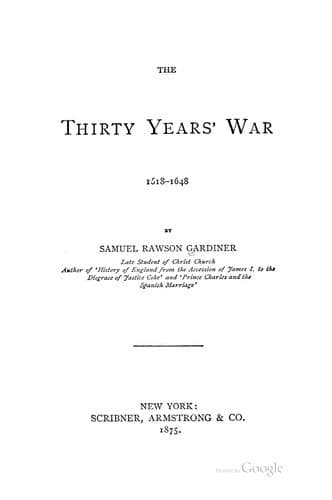
The Thirty Years' War, 1618-1648Gardiner, Samuel Rawson
History
The Thirty Years' War, 1618-1648
Gardiner, Samuel Rawson
Thirty Years' War, 1618-1648
The long expected breach between the League and the Emperor's general
had come at last. Instead of reducing his forces after the Peace of
Lübeck, Wallenstein had increased them. He was now at the head of
100,000 men. From a military point of view no one could say it was too
much. He had Mantua to defend, the coasts of the North Sea to watch,
perhaps France to guard against, and that too with all the princes and
peoples of Germany exasperated against him. Some efforts he made to curb
the violence of his soldiers. But to restrain the monster he had created
was beyond his power. And if his soldiers bore hard upon burgher and
peasant, he himself treated the princes with contemptuous scorn. He
asked why the electors and the other princes should not be treated as
the Bohemian nobles had been treated. The Estates of the Empire had no
more right to independence than the Estates of the kingdom. It was time
for the Emperor to make himself master of Germany, as the kings of
France and Spain were masters of their own dominions. All this made the
electors above measure indignant. "A new domination," they told
Ferdinand, "has arisen for the complete overthrow of the old and
praiseworthy constitution of the Empire."
[Sidenote: § 2. What could he effect?]
A reconstruction of that old rotten edifice would have done no harm. But
its overthrow by military violence was another matter. A new form of
government, to be exercised by a soldier with the help of soldiers,
could never be found in justice,
For always formidable was the league
And partnership of free power and free will.
The way of ancient ordinances, though it winds,
Is yet no devious path. Straight forward goes
The lightning's path, and straight the fearful path
Of the cannon-ball. Direct it flies, and rapid,
Shattering that it may reach, and shattering what it reaches.
Schiller's _Piccolomini_, act i. scene 4.
[Sidenote: § 3. His partiality.]
Even whilst he was defending the universality of oppression on the
principle that it was but fair that all estates should contribute to the
common defence, he was exhibiting in his own case an extraordinary
instance of partiality. Whilst all Germany was subjected to contributions
and exactions, not a soldier was allowed to set foot on Wallenstein's
own duchy of Mecklenburg.
[Sidenote: § 4. The Edict of Restitution carried out.]
Public-domain text, read in full here on John Shaqi.
Reviews
Reviews
No reviews yet
Be the first to share your thoughts on this work.
Elsewhere in the archive
Join the Discussion
Join the discussion
Sign in to leave a comment or review.
Sign InorCreate an account