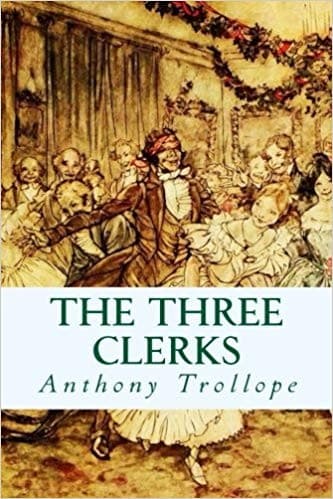
Civil service -- Fiction; London (England) -- Fiction
Alaric Tudor was deeply grieved for his friend. There was something in
the rejected suitor's countenance--something in the tone of voice, which
would have touched any heart softer than stone; and Alaric's heart had
not as yet been so hardened by the world as to render him callous to the
sight of such grief as this.
'Take my word for it, Harry, she'll think better of it in a month or
two,' he said.
'Never--never; I am sure of it. Not only from her own manner, but from
her mother's,' said Harry. And yet, during half his walk home, he had
been trying to console himself with the reflection that most young
ladies reject their husbands once or twice before they accept them.
There is no offering a man comfort in such a sorrow as this; unless,
indeed, he be one to whom the worship of Bacchus may be made a fitting
substitute for that of the Paphian goddess.
There is a sort of disgrace often felt, if never acknowledged, which
attaches itself to a man for having put himself into Norman's present
position, and this generally prevents him from confessing his defeat in
such matters. The misfortune in question is one which doubtless occurs
not unfrequently to mankind; but as mankind generally bear their special
disappointments in silence, and as the vanity of women is generally
exceeded by their good-nature, the secret, we believe, in most cases
remains a secret.
Shall I, wasting in despair,
Die because a woman's fair?
If she be not fair for me,
What care I how fair she be?
This was the upshot of the consideration which Withers, the poet, gave
to the matter, and Withers was doubtless right. 'Tis thus that rejected
lovers should think, thus that they should demean themselves; but they
seldom come to this philosophy till a few days have passed by, and
talking of their grievance does not assist them in doing so.
When, therefore, Harry had declared what had happened to him, and had
declared also that he had no further hope, he did not at first find
himself much the better for what he had confessed. He was lackadaisical
and piteous, and Alaric, though he had endeavoured to be friendly, soon
found that he had no power of imparting any comfort. Early in the
day they parted, and did not see each other again till the following
morning.
'I was going down to Normansgrove on Thursday,' said Harry.
'Yes, I know,' said Alaric.
'I think I shall ask leave to go to-day. It can't make much difference,
and the sooner I get away the better.'
And so it was settled. Norman left town the same afternoon, and Alaric,
with his blushing honours thick upon him, was left alone.
Public-domain text, read in full here on John Shaqi.
Reviews
Reviews
No reviews yet
Be the first to share your thoughts on this work.
Elsewhere in the archive
Join the Discussion
Join the discussion
Sign in to leave a comment or review.
Sign InorCreate an account