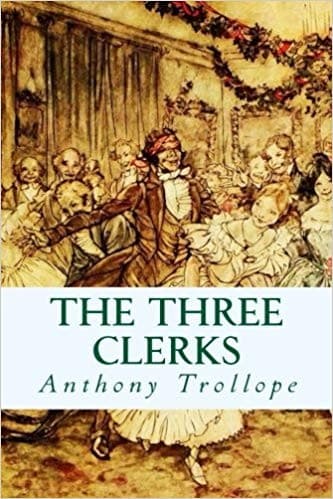
Civil service -- Fiction; London (England) -- Fiction
And then the committee met, and a lot of witnesses were in attendance.
The chairman opened his case, and proceeded to prove, by the evidence
of sundry most respectable men connected with Limehouse, and with the
portions of Surrey and Kent lying immediately opposite to it, that the
most intense desire for friendly and commercial intercourse was felt;
but that, though absolutely close to each other, the districts were so
divided by adverse circumstances, circumstances which were monstrous
considering the advance of science in the nineteenth century, that
the dearest friends were constrained to perpetual banishment from each
other; and that the men of Kent were utterly unable to do any trade at
Limehouse, and the Limehousians equally unable to carry on traffic in
Surrey.
It was wonderful that the narrow river should be so effective for
injury. One gentleman from Poplar proved that, having given his daughter
in marriage to a man of Deptford two years since, he had not yet been
able to see her since that day. Her house, by the crow's flight, was but
seven furlongs from his own; but, as he kept no horse, he could not get
to her residence without a four hours' walk, for which he felt himself
to be too old. He was, however, able to visit his married daughter at
Reading, and be back to tea. The witness declared that his life was made
miserable by his being thus debarred from his child, and he wiped his
eyes with his pocket-handkerchief piteously, sitting there in front of
the committee. In answer to Mr. Vigil he admitted that there might be a
ferry, but stated that he did not know. Having had, from childhood, an
aversion to the water, he had not inquired. He was aware that some rash
people had gone through the Tunnel, but for himself he did not think the
Tunnel a safe mode of transit.
Another gentleman belonging to Rotherhithe, who was obliged to be almost
daily at Blackwall, maintained two horses for the express purpose of
going backwards and forwards, round by London Bridge. They cost him
£70 per annum each. Such a bridge as that now proposed, and which the
gentleman declared that he regarded as an embryo monument of national
glory, would save him £140 per annum. He then proceeded to make a little
speech about the spirit of the age, and the influence of routine, which
he described as a gloomy gnome. But his oratory was cruelly cut short by
Mr. Vigil, who demanded of him whether he ever used the river steamers.
The witness shuddered fearfully as he assured the committee that he
never did, and referred to the _Cricket_, whose boilers burst in the
year 1842; besides, he had, he said, his things to carry with him.
Public-domain text, read in full here on John Shaqi.
Reviews
Reviews
No reviews yet
Be the first to share your thoughts on this work.
Elsewhere in the archive
Join the Discussion
Join the discussion
Sign in to leave a comment or review.
Sign InorCreate an account