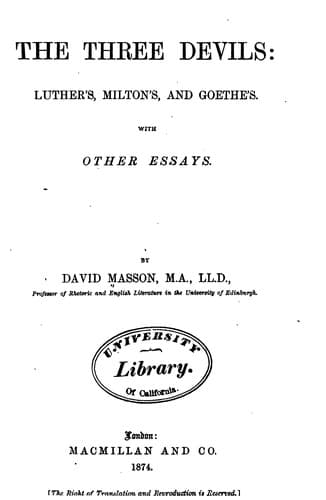
The Three Devils: Luther's, Milton's, and Goethe's; With Other EssaysMasson, David
History
The Three Devils: Luther's, Milton's, and Goethe's; With Other Essays
Masson, David
Devil in literature; Literature -- History and criticism
tried to compass by cabal and systematic depreciation on particular
points. In fact, Dryden had to fight pretty hard to maintain his place,
and had to make an example or two of a rebel subject before the rest were
terrified into submission.
He was first attacked in the very field of his greatest triumphs, the
drama. The attack was partly directed against himself personally, partly
against that style of heroic or rhymed tragedy of which he was the
advocate and representative. There had always been dissenters from this
new fashion; and among these was the Duke of Buckingham, who had a natural
genius for making fun of anything. Assisted, it is said, by his chaplain
Sprat, and by Butler, who had already satirized this style of tragedy by
writing a dialogue in which two cats are made to caterwaul to each other
in heroics, the duke had amused his leisure by preparing a farce in which
heroic plays were held up to ridicule. In the original draft of the farce
Davenant was made the butt under the name of Bilboa; but, after Davenant's
death, the farce was recast, and Dryden substituted under the name of
Bayes. The plot of this famous farce, _The Rehearsal_, is much the same as
that of Sheridan's _Critic_. The poet Bayes invites two friends, Smith
and Johnson, to be present at the rehearsal of a heroic play which he is
on the point of bringing out, and the humour consists in the supposed
representation of this heroic play, while Bayes alternately directs the
actors, and expounds the drift of the play and its beauties to Smith and
Johnson, who all the while are laughing at him, and thinking it monstrous
rubbish. Conceive a farce like this, written with amazing cleverness, and
full of absurdities, produced in the very theatre where the echoes of
Dryden's last sonorous heroics were still lingering, and acted by the same
actors; conceive it interspersed with parodies of well-known passages from
Dryden's plays, and with allusions to characters in those plays; conceive
the actor who played the part of Bayes dressed to look as like Dryden as
possible, instructed by the duke to mimic Dryden's voice, and using
phrases like "i'gad" and "i'fackins," which Dryden was in the habit of
using in familiar conversation; and an idea may be formed of the sensation
made by _The Rehearsal_ in all theatrical circles on its first performance
in the winter of 1671. Its effect, though not immediate, was decisive.
From that time the heroic or rhymed tragedy was felt to be doomed. Dryden,
indeed, did not at once recant his opinion in favour of rhymed tragedies;
but he yielded so far to the sentence pronounced against them as to write
only one more of the kind.
Public-domain text, read in full here on John Shaqi.
Reviews
Reviews
No reviews yet
Be the first to share your thoughts on this work.
Elsewhere in the archive
Join the Discussion
Join the discussion
Sign in to leave a comment or review.
Sign InorCreate an account