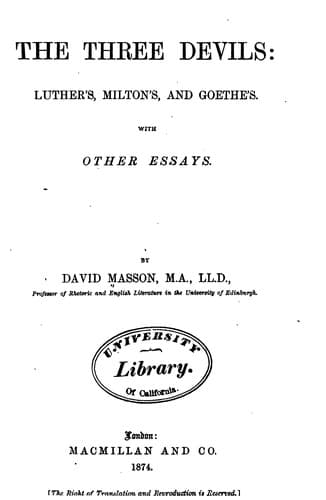
The Three Devils: Luther's, Milton's, and Goethe's; With Other EssaysMasson, David
History
The Three Devils: Luther's, Milton's, and Goethe's; With Other Essays
Masson, David
Devil in literature; Literature -- History and criticism
The conclusion which we have thus reached vindicates that mood of mind
towards the whole historical past which we find to have been actually the
mood of all the great masters of literature whenever they have ranged back
in the past for their themes. When Shakespeare writes of Richard II., who
lived two hundred years before his own time, does he not overleap those
two hundred years as a mere nothing, plunge in among Richard's Englishmen
as intrinsically not different from so many great Elizabethans, make them
talk and act as co-equals in whom Elizabethans could take an interest, and
even fill the mouth of the weak monarch himself with soliloquies of
philosophic melancholy and the kingliest verbal splendours? And so when
the same poet goes back into a still remoter antique, as in the council of
the Greek chiefs in his _Troilus and Cressida_. We speak of Shakespeare's
anachronisms in such cases. There they are certainly for the critic to
note; but they only serve to bring out more clearly his main principle in
his art--his sense or instinct, for all historic time, of a grand
over-matching synchronism. And, indeed, without something of this
instinct--this sense of an intrinsic traditional humanity persisting
through particular progressive variations, this belief in a co-equality of
at least some minds through all the succession of human ages in what we
call the historic period--what were the past of mankind to us much more
than a history of dogs or ruminants? Nay, and with that measure with which
we mete out to others, with the same measure shall it not be meted out to
ourselves? If to be dead is to be inferior, and if to be long dead is to
be despicable, to the generation in possession, shall not we who are in
possession now have passed into the state of inferiority to-morrow, with
all the other defunct beyond us, and will not a time come when some far
future generation will lord it on the earth, and _we_ shall lie deep, deep
down, among the strata of the despicable?
THE END.
LONDON; R. CLAY, SONS, AND TAYLOR, PRINTERS.
Footnotes:
[1] _Fraser's Magazine_, Dec. 1844.
[2] _British Quarterly Review_, November, 1852.--1. "Shakspeare and His
Times." By M. Guizot. 1852.--2. "Shakspeare's Dramatic Art; and his
Relation to Calderon and Goethe." Translated from the German of Dr.
Hermann Ulrici. 1846.--3. "Conversations of Goethe with Eckermann and
Soret." Translated from the German by John Oxenford. 2 vols. 1850.
[3] According to Mr. Lewes, in his Life of Goethe, it is a mistake to
fancy that Goethe was tall. He seemed taller than he really was.
Public-domain text, read in full here on John Shaqi.
Reviews
Reviews
No reviews yet
Be the first to share your thoughts on this work.
Elsewhere in the archive
Join the Discussion
Join the discussion
Sign in to leave a comment or review.
Sign InorCreate an account