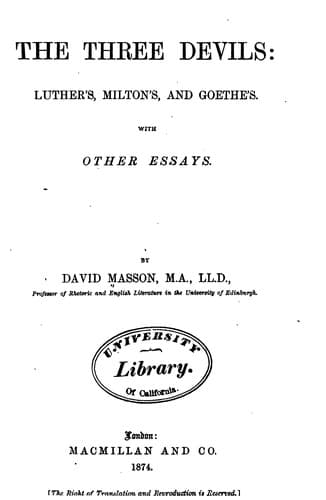
The Three Devils: Luther's, Milton's, and Goethe's; With Other EssaysMasson, David
History
The Three Devils: Luther's, Milton's, and Goethe's; With Other Essays
Masson, David
Devil in literature; Literature -- History and criticism
_Rosalind._ Those that are in extremity of either are abominable
fellows, and betray themselves to every modern censure worse than
drunkards.
_Jaques._ Why, 'tis good to be sad and say nothing.
_Rosalind._ Why, then, 'tis good to be a post.
_Jaques._ I have neither the scholar's melancholy, which is
emulation; nor the musician's, which is fantastical; nor the
courtier's, which is proud; nor the soldier's, which is ambitious;
nor the lawyer's, which is politic; nor the lady's, which is nice;
nor the lover's, which is all these: but it is a melancholy of mine
own, compounded of many simples, extracted from many objects, and
indeed the sundry contemplation of my travels, in which my often
rumination wraps me in a most humorous sadness."
Jaques is not Shakespeare; but in writing this description of Jaques
Shakespeare drew from his knowledge of himself. His also was a "melancholy
of his own," a "humorous sadness in which his often rumination wrapt him."
In that declared power of Jaques of "sucking melancholy out of a song" the
reference of Shakespeare to himself seems almost direct. Nay more, as
Rosalind, in rating poor Jaques, tells him on one occasion that he is so
abject a fellow that she verily believes he is "out of love with his
nativity, and almost chides God _for making him of that countenance that
he is_," so Shakespeare's melancholy, in one of his Sonnets (No. 29),
takes exactly the same form of self-dissatisfaction.
"When, in disgrace with fortune and men's eyes,
I all alone beweep my outcast state,
And trouble deaf heaven with my bootless cries,
And look upon myself and curse my fate,
Wishing me like to one more rich in hope,
_Featured like him_, like him with friends possessed,
Desiring this man's art and that man's scope,
With what I most enjoy contented least;
Yet, in these thoughts myself almost despising,
Haply I think on thee," &c.
Think of that, reader! That mask of Shakespeare's face, which we have been
discussing, Shakespeare himself did not like; and there were moments in
which he was so abject as actually to wish that he had received from
Nature another man's physical features!
Public-domain text, read in full here on John Shaqi.
Reviews
Reviews
No reviews yet
Be the first to share your thoughts on this work.
Join the Discussion
Join the discussion
Sign in to leave a comment or review.
Sign InorCreate an account