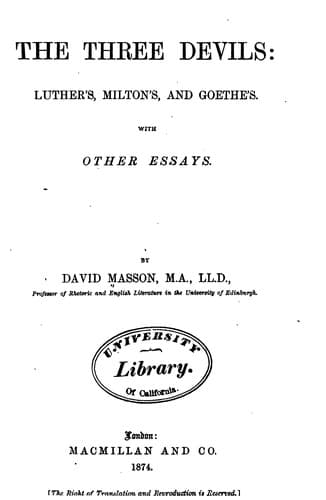
The Three Devils: Luther's, Milton's, and Goethe's; With Other Essays — John Shaqi
The Three Devils: Luther's, Milton's, and Goethe's; With Other EssaysMasson, David
History
The Three Devils: Luther's, Milton's, and Goethe's; With Other Essays
Masson, David
Devil in literature; Literature -- History and criticism
At no time, except during sleep, is the mind of any human being completely
idle. All men have some natural and congenial mood into which they fall
when they are left to talk with themselves. One man recounts the follies
of the past day, renewing the relish of them by the recollection; another
uses his leisure to hate his enemy and to scheme his discomfiture; a third
rehearses in imagination, in order to be prepared, the part which he is to
perform on the morrow. Now, at such moments, as we believe, it was the
habit of Shakespeare's mind, obliged thereto by the necessity of its
structure, to ponder ceaselessly those quest ions relating to man, his
origin, and his destiny, in familiarity with which consists what is called
the spiritual element in human nature. It was Shakespeare's use, as it
seems to us, to revert, when he was alone, to that ultimate mood of the
soul in which one hovers wistfully on the borders of the finite, vainly
pressing against the barriers that separate it from the unknown; that mood
in which even what is common and under foot seems part of a vast current
mystery, and in which, like Arabian Job of old, one looks by turns at the
heaven above, the earth beneath, and one's own moving body between,
interrogating whence it all is, why it all is, and whither it all tends.
And this, we say, is Melancholy. It is more. It is that mood of man,
which, most of all moods, is thoroughly, grandly, specifically human. That
which is the essence of all worth, all beauty, all humour, all genius, is
open or secret reference to the supernatural; and this is sorrow. The
attitude of a finite creature, contemplating the infinite, can only be
that of an exile, grief and wonder blending in a wistful longing for an
unknown home.
As we consider this frame of mind to have been characteristic of
Shakespeare, so we find that as a poet he has not forgotten to represent
it. We have always fancied Hamlet to be a closer translation of
Shakespeare's own character than any other of his personations. The same
meditativeness, the same morbid reference at all times to the
supernatural, the same inordinate development of the speculative faculty,
the same intellectual melancholy, that are seen in the Prince of Denmark,
seem to have distinguished Shakespeare. Nor is it possible here to forget
that minor and lower form of the same fancy--the ornament of _As You Like
It_, the melancholy Jaques.
"_Jaques._ More, more, I prithee, more.
_Amiens._ It will make you melancholy, Monsieur Jaques.
_Jaques._ I thank it. More, I prithee, more! I can suck melancholy
out of a song, as a weasel sucks eggs. More. I prithee, more!
_Amiens._ My voice is ragged; I know I cannot please you.
_Jaques._ I do not desire you to please me; I desire you to sing.
* * * * *
_Rosalind._ They say you are a melancholy fellow.
_Jaques._ I am so; I do love it better than laughing.
Public-domain text, read in full here on John Shaqi.
Reviews
Reviews
No reviews yet
Be the first to share your thoughts on this work.
Join the Discussion
Join the discussion
Sign in to leave a comment or review.
Sign InorCreate an account