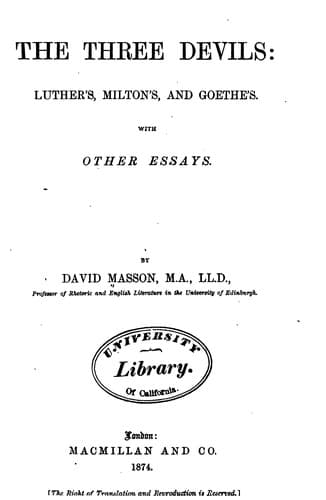
The Three Devils: Luther's, Milton's, and Goethe's; With Other EssaysMasson, David
History
The Three Devils: Luther's, Milton's, and Goethe's; With Other Essays
Masson, David
Devil in literature; Literature -- History and criticism
If Shakespeare's melancholy was, like that of Jaques, a complex
melancholy, a melancholy "compounded of many simples"--extracted perhaps
at first from some root of bitter experience in his own life, and then
fed, as his Sonnets clearly state, by a habitual sense of his own
"outcast" condition in society, and by the sight of a hundred social
wrongs around him, into a kind of abject dissatisfaction with himself and
his fate--yet, in the end, and in its highest form, it was rather, as we
have already hinted, the melancholy of Hamlet, a meditative, contemplative
melancholy, embracing human life as a whole, the melancholy of a mind
incessantly tending from the real ([Greek: ta physika]) to the
metaphysical ([Greek: ta meta ta physika]), and only brought back by
external occasion from the metaphysical to the real.
Do not let us quarrel about the words, if we can agree about the thing.
Let any competent person whatever read the Sonnets, and then, with their
impression on him, pass to the plays, and he will inevitably become aware
of Shakespeare's personal fondness for certain themes or trains of
thought, particularly that of the speed and destructiveness of time.
Death, vicissitude, the march and tramp of generations across life's
stage, the rotting of human bodies in the earth--these and all the other
forms of the same thought were familiar to Shakespeare to a degree beyond
what is to be seen in the case of any other poet. It seems to have been a
habit of his mind, when left to its own tendency, ever to indulge by
preference in that oldest of human meditations, which is not yet trite:
"Man that is born of a woman is of few days, and full of trouble; he
cometh forth as a flower, and is cut down: he fleeth as a shadow, and
continueth not." Let us cite a few examples from the Sonnets:--
"When I consider everything that grows
Holds in perfection but a little moment,
That this huge stage presenteth nought but shows
Whereon the stars in secret influence comment."--
_Sonnet 15._
"If thou survive my well-contented clay,
When that churl Death my bones with dust shall
cover."-- _Sonnet 32._
"No longer mourn for me when I am dead
Than you shall hear the surly sullen bell
Give warning to the world that I am fled
From this vile world, with vilest worms to dwell."--
_Sonnet 71._
"The wrinkles, which thy glass will truly show,
Of mouthed graves will give thee memory;
Thou by thy dial's shady stealth may'st know
Time's thievish progress to eternity."--
_Sonnet 77._
"Or I shall live your epitaph to make,
Or you survive when I in earth am rotten."--
_Sonnet 81._
Public-domain text, read in full here on John Shaqi.
Reviews
Reviews
No reviews yet
Be the first to share your thoughts on this work.
Join the Discussion
Join the discussion
Sign in to leave a comment or review.
Sign InorCreate an account