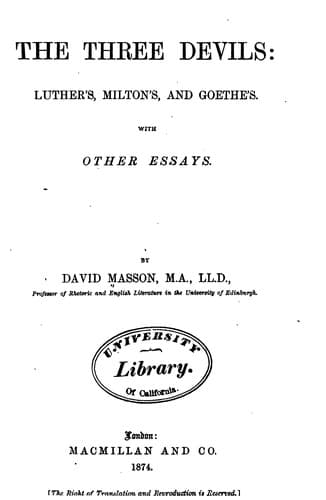
The Three Devils: Luther's, Milton's, and Goethe's; With Other EssaysMasson, David
History
The Three Devils: Luther's, Milton's, and Goethe's; With Other Essays
Masson, David
Devil in literature; Literature -- History and criticism
And so it is throughout Shakespeare's writings. Whatever is special or
doctrinal is avoided; all that intellectual tackling, so to speak, is
struck away that would afford the soul any relief whatever from the whole
sensation of the supernatural. Although we cannot, therefore, in honest
keeping with popular language, call Shakespeare, as Ulrici does, the most
Christian of poets, we believe him to have been the man in modern times
who, breathing an atmosphere full of Christian conceptions, and walking
amid a civilization studded with Christian institutions, had his whole
being tied by the closest personal links to those highest generalities of
the universe which the greatest minds in all ages have ever pondered and
meditated, and round which Christianity has thrown its clasp of gold.
Shakespeare, then, we hold to have been essentially a meditative,
speculative, and even, in his solitary hours, an abject and melancholy
man, rather than a man of active, firm, and worldly disposition. Instead
of being a calm, stony observer of life and nature, as he has been
sometimes represented, we believe him to have been a man of the gentlest
and most troublesome affections, of sensibility abnormally keen and deep,
full of metaphysical longings, liable above most men to self-distrust,
despondency, and mental agitation from causes internal and external, and a
prey to many secret and severe experiences which he did not discuss at the
Mermaid tavern. This, we say, is no guess; it is a thing certified under
his own hand and seal. But, this being allowed, we are willing to agree
with all that is said of him, by way of indicating the immense variety of
faculties, dispositions, and acquirements, of which his character was
built up. Vast intellectual inquisitiveness, the readiest and most
universal humour, the truest sagacity and knowledge of the world, the
richest and deepest capacity of enjoying all that life presented: all
this, as applied to Shakespeare, is a mere string of undeniable
commonplaces. The man, as we fancy him, who of all others trod the
oftenest the extreme metaphysic walk which bounds our universe in, he was
also the man of all others who was related most keenly by every fibre of
his being to all the world of the real and the concrete. Better than any
man he knew life to be a dream; with as vivid a relish as any man he did
his part as one of the dreamers. If at one moment life stood before his
mental gaze, an illuminated little speck or disc, softly rounded with
mysterious sleep, the next moment this mere span shot out into an
illimitable plain, whereon he himself stood--a plain covered with forests,
parted by seas, studded with cities and huge concourses of men, mapped out
into civilizations, over-canopied by stars. Nay, it was precisely because
he came and went with such instant transition between the two extremes
that he behaved so genially and sympathetically in the latter. It was
Public-domain text, read in full here on John Shaqi.
Reviews
Reviews
No reviews yet
Be the first to share your thoughts on this work.
Join the Discussion
Join the discussion
Sign in to leave a comment or review.
Sign InorCreate an account