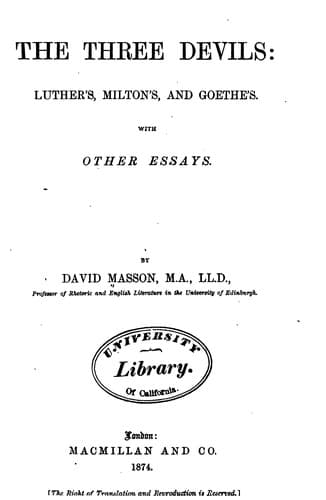
The Three Devils: Luther's, Milton's, and Goethe's; With Other EssaysMasson, David
History
The Three Devils: Luther's, Milton's, and Goethe's; With Other Essays
Masson, David
Devil in literature; Literature -- History and criticism
In this extreme familiarity with the conception of mortality in general,
and perhaps also in this extreme sensitiveness to the thought of death as
a matter of personal import, all great poets, and possibly all great men
whatever, have to some extent resembled Shakespeare. For these are the
feelings of our common nature on which religion and all solemn activity
have founded and maintained themselves. Space and Time are the largest and
the outermost of all human conceptions; to stand, therefore, incessantly
upon these extreme conceptions, as upon the perimeter of a figure, and to
view all inwards from them, is the highest exercise of thought to which a
human being can attain. Accordingly, in all great poets there may be
discerned this familiarity of the imagination with the world figured as a
poor little ball pendent in space and moving forward out of a dark past to
a future of light or gloom. But in this respect Shakespeare exceeds them
all; and in this respect, therefore, no poet is more religious, more
spiritual, more profoundly metaphysical, than he. Into an inordinate
amount of that outward pressure of the soul against the perimeter of
sensible things, infuse the peculiar _moral_ germ of Christianity, and you
have the religion of Shakespeare. Thus:--
"And our little life
Is rounded with a sleep."--_Tempest._
Here the poetic imagination sweeps boldly round the universe, severing it
as by a soft cloud-line from the infinite Unknown.
"Poor soul! the centre of my sinful earth,
Fooled by those rebel powers that lead thee 'stray!"
_Sonnet 146._
Here the soul, retracting its thoughts from the far and physical, dwells
disgustedly on itself.
"The dread of something after death,
The undiscovered country from whose bourn
No traveller returns."--_Hamlet._
Here the soul, pierced with the new and awful thought of sin, wings out
again towards the Infinite, and finds all dark.
"How would you be,
If He, which is the top of judgment, should
But judge you as you are?"--_Measure for Measure._
Here the silver lamp of hope is hung up within the gloomy sphere, to burn
softly and faintly for ever!
Public-domain text, read in full here on John Shaqi.
Reviews
Reviews
No reviews yet
Be the first to share your thoughts on this work.
Join the Discussion
Join the discussion
Sign in to leave a comment or review.
Sign InorCreate an account