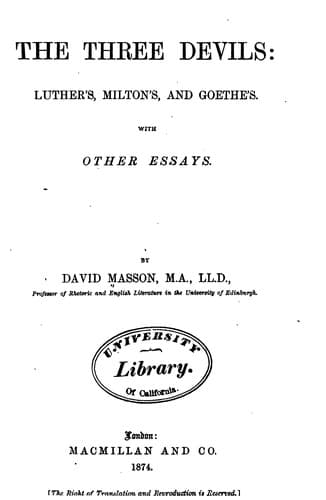
The Three Devils: Luther's, Milton's, and Goethe's; With Other EssaysMasson, David
History
The Three Devils: Luther's, Milton's, and Goethe's; With Other Essays
Masson, David
Devil in literature; Literature -- History and criticism
How, then, _did_ Shakespeare relate himself to this concrete world of
nature and life in which his lot had been cast? What precise function with
regard to it, if not that of an active partisan of progress, did he accept
as devolving naturally on _him_? The answer is easy. Marked out by
circumstances, and by his own bent and inclination, from the vast
majority of men, who, with greater or less faculty, sometimes perhaps with
the greatest, pass their lives in silence, appearing in the world at their
time, enjoying it for a season, and returning to the earth again,--marked
out from among these, and appointed to be one of those whom the whole
earth should remember and think of; yet precluded, as we have seen, by his
constitution and fortune, from certain modes of attaining to this
honour--the special function which, in this high place, he saw himself
called upon to discharge, and by the discharge of which he has ensured his
place in perpetuity, was simply that of _expressing_ what he felt and saw.
In other words, Shakespeare was specifically and transcendently a literary
man. To say that he was the greatest _man_ that ever lived is to provoke a
useless controversy, and comparisons that lead to nothing, between
Shakespeare and Cæsar, Shakespeare and Charlemagne, Shakespeare and
Cromwell; to say that he was the greatest _intellect_ that ever lived, is
to bring the shades of Aristotle and Plato, and Bacon and Newton, and all
the other systematic thinkers, grumbling about us, with demands for a
definition of intellect, which we are by no means in a position to give;
nay, finally, to say that he is the greatest _poet_ that the world has
produced (a thing which we would certainly say, were we provoked to it,)
would be unnecessarily to hurt the feelings of Homer and Sophocles, Dante
and Milton. What we will say, then, and challenge the world to gainsay, is
that he was the greatest _expresser_ that ever lived. This is glory
enough, and it leaves the other questions open. Other men may have led, on
the whole, greater and more impressive lives than he; other men, acting on
their fellows through the same medium of speech that he used, may have
expended a greater power of thought, and achieved a greater intellectual
effect, in one consistent direction; other men, too (though this is very
questionable), may have contrived to issue the matter which they did
address to the world in more compact and perfect artistic shapes. But no
man that ever lived said such splendid things on all subjects universally;
no man that ever lived had the faculty of pouring out on all occasions
such a flood of the richest and deepest language. He may have had rivals
in the art of imagining situations; he had no rival in the power of
sending a gush of the appropriate intellectual effusion over the image and
body of a situation once conceived. From a jewelled ring on an alderman's
finger to the most mountainous thought or deed of man or demon, nothing
Public-domain text, read in full here on John Shaqi.
Reviews
Reviews
No reviews yet
Be the first to share your thoughts on this work.
Elsewhere in the archive
Join the Discussion
Join the discussion
Sign in to leave a comment or review.
Sign InorCreate an account