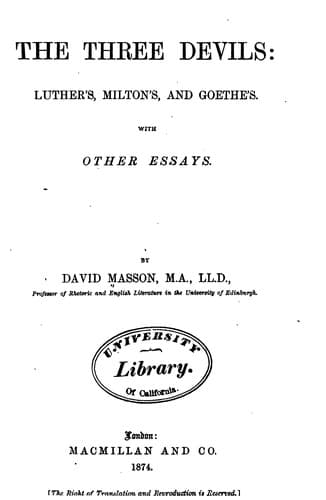
The Three Devils: Luther's, Milton's, and Goethe's; With Other EssaysMasson, David
History
The Three Devils: Luther's, Milton's, and Goethe's; With Other Essays
Masson, David
Devil in literature; Literature -- History and criticism
suggested itself that his speech could not envelope and enfold with ease.
That excessive fluency which astonished Ben Jonson when he listened to
Shakespeare in person astonishes the world yet. Abundance, ease,
redundance, a plenitude of word, sound, and imagery, which, were the
intellect at work only a little less magnificent, would sometimes end in
sheer braggartism and bombast, are the characteristics of Shakespeare's
style. Nothing is suppressed, nothing omitted, nothing cancelled. On and
on the poet flows; words, thoughts, and fancies crowding on him as fast as
he can write, all related to the matter on hand, and all poured forth
together, to rise and fall on the waves of an established cadence. Such
lightness and ease in the manner, and such prodigious wealth and depth in
the matter, are combined in no other writer. How the matter was first
accumulated, what proportion of it was the acquired capital of former
efforts, and what proportion of it welled up in the poet's mind during and
in virtue of the very act of speech, it is impossible to say; but this at
least may be affirmed without fear of contradiction, that there never was
a mind in the world from which, when it was pricked by any occasion
whatever, there poured forth on the instant such a stream of precious
substance intellectually related to it. By his powers of expression, in
fact, Shakespeare has beggared all his posterity, and left mere
practitioners of expression nothing possible to do. There is perhaps not a
thought, or feeling, or situation, really common and generic to human
life, on which he has not exercised his prerogative; and, wherever he has
once been, woe to the man that comes after him! He has overgrown the
whole system and face of things like a universal ivy, which has left no
wall uncovered, no pinnacle unclimbed, no chink unpenetrated. Since he
lived the concrete world has worn a richer surface. He found it great and
beautiful, with stripes here and there of the rough old coat seen through
the leafy labours of his predecessors; he left it clothed throughout with
the wealth and autumnal luxuriance of his own unparalleled language.
* * * * *
Public-domain text, read in full here on John Shaqi.
Reviews
Reviews
No reviews yet
Be the first to share your thoughts on this work.
Elsewhere in the archive
Join the Discussion
Join the discussion
Sign in to leave a comment or review.
Sign InorCreate an account