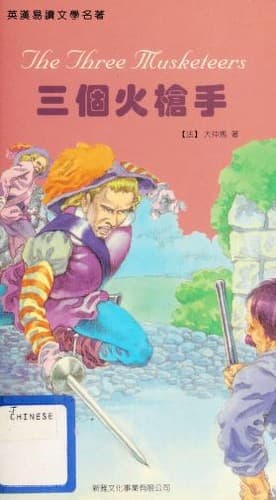
Adventure and adventurers -- Fiction; France -- History -- Louis XIII, 1610-1643 -- Fiction; Historical fiction; Swordsmen -- Fiction
“Why, here is the simple fact. This morning I awoke at six o’clock. You
were still fast asleep, and I did not know what to do with myself; I
was still stupid from our yesterday’s debauch. As I came into the
public room, I saw one of our Englishman bargaining with a dealer for a
horse, his own having died yesterday from bleeding. I drew near, and
found he was bidding a hundred pistoles for a chestnut nag.
‘_Pardieu_,’ said I, ‘my good gentleman, I have a horse to sell, too.’
‘Ay, and a very fine one! I saw him yesterday; your friend’s lackey was
leading him.’ ‘Do you think he is worth a hundred pistoles?’ ‘Yes! Will
you sell him to me for that sum?’ ‘No; but I will play for him.’
‘What?’ ‘At dice.’ No sooner said than done, and I lost the horse. Ah,
ah! But please to observe I won back the equipage,” cried Athos.
D’Artagnan looked much disconcerted.
“This vexes you?” said Athos.
“Well, I must confess it does,” replied D’Artagnan. “That horse was to
have identified us in the day of battle. It was a pledge, a
remembrance. Athos, you have done wrong.”
“But, my dear friend, put yourself in my place,” replied the Musketeer.
“I was hipped to death; and still further, upon my honor, I don’t like
English horses. If it is only to be recognized, why the saddle will
suffice for that; it is quite remarkable enough. As to the horse, we
can easily find some excuse for its disappearance. Why the devil! A
horse is mortal; suppose mine had had the glanders or the farcy?”
D’Artagnan did not smile.
“It vexes me greatly,” continued Athos, “that you attach so much
importance to these animals, for I am not yet at the end of my story.”
“What else have you done.”
“After having lost my own horse, nine against ten—see how near—I formed
an idea of staking yours.”
“Yes; but you stopped at the idea, I hope?”
“No; for I put it in execution that very minute.”
“And the consequence?” said D’Artagnan, in great anxiety.
“I threw, and I lost.”
“What, my horse?”
“Your horse, seven against eight; a point short—you know the proverb.”
“Athos, you are not in your right senses, I swear.”
“My dear lad, that was yesterday, when I was telling you silly stories,
it was proper to tell me that, and not this morning. I lost him then,
with all his appointments and furniture.”
“Really, this is frightful.”
“Stop a minute; you don’t know all yet. I should make an excellent
gambler if I were not too hot-headed; but I was hot-headed, just as if
I had been drinking. Well, I was not hot-headed then—”
“Well, but what else could you play for? You had nothing left?”
“Oh, yes, my friend; there was still that diamond left which sparkles
on your finger, and which I had observed yesterday.”
“This diamond!” said D’Artagnan, placing his hand eagerly on his ring.
“And as I am a connoisseur in such things, having had a few of my own
once, I estimated it at a thousand pistoles.”
“I hope,” said D’Artagnan, half dead with fright, “you made no mention
of my diamond?”
Public-domain text, read in full here on John Shaqi.
Reviews
Reviews
No reviews yet
Be the first to share your thoughts on this work.
Elsewhere in the archive
Join the Discussion
Join the discussion
Sign in to leave a comment or review.
Sign InorCreate an account