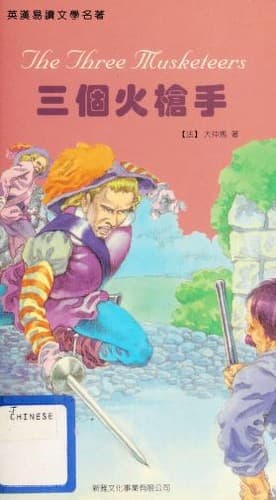
Adventure and adventurers -- Fiction; France -- History -- Louis XIII, 1610-1643 -- Fiction; Historical fiction; Swordsmen -- Fiction
He continued his way toward the Quai des Grands Augustins, while the
two friends went to ring at the bell of the unfortunate Porthos. He,
having seen them crossing the yard, took care not to answer, and they
rang in vain.
Meanwhile Mousqueton continued on his way, and crossing the Pont Neuf,
still driving the two sorry animals before him, he reached the Rue aux
Ours. Arrived there, he fastened, according to the orders of his
master, both horse and mule to the knocker of the procurator’s door;
then, without taking any thought for their future, he returned to
Porthos, and told him that his commission was completed.
In a short time the two unfortunate beasts, who had not eaten anything
since the morning, made such a noise in raising and letting fall the
knocker that the procurator ordered his errand boy to go and inquire in
the neighborhood to whom this horse and mule belonged.
Mme. Coquenard recognized her present, and could not at first
comprehend this restitution; but the visit of Porthos soon enlightened
her. The anger which fired the eyes of the Musketeer, in spite of his
efforts to suppress it, terrified his sensitive inamorata. In fact,
Mousqueton had not concealed from his master that he had met D’Artagnan
and Aramis, and that D’Artagnan in the yellow horse had recognized the
Béarnese pony upon which he had come to Paris, and which he had sold
for three crowns.
Porthos went away after having appointed a meeting with the
procurator’s wife in the cloister of St. Magloire. The procurator,
seeing he was going, invited him to dinner—an invitation which the
Musketeer refused with a majestic air.
Mme. Coquenard repaired trembling to the cloister of St. Magloire, for
she guessed the reproaches that awaited her there; but she was
fascinated by the lofty airs of Porthos.
All that which a man wounded in his self-love could let fall in the
shape of imprecations and reproaches upon the head of a woman Porthos
let fall upon the bowed head of the procurator’s wife.
“Alas,” said she, “I did all for the best! One of our clients is a
horsedealer; he owes money to the office, and is backward in his pay. I
took the mule and the horse for what he owed us; he assured me that
they were two noble steeds.”
“Well, madame,” said Porthos, “if he owed you more than five crowns,
your horsedealer is a thief.”
“There is no harm in trying to buy things cheap, Monsieur Porthos,”
said the procurator’s wife, seeking to excuse herself.
“No, madame; but they who so assiduously try to buy things cheap ought
to permit others to seek more generous friends.” And Porthos, turning
on his heel, made a step to retire.
“Monsieur Porthos! Monsieur Porthos!” cried the procurator’s wife. “I
have been wrong; I see it. I ought not to have driven a bargain when it
was to equip a cavalier like you.”
Public-domain text, read in full here on John Shaqi.
Reviews
Reviews
No reviews yet
Be the first to share your thoughts on this work.
Elsewhere in the archive
Join the Discussion
Join the discussion
Sign in to leave a comment or review.
Sign InorCreate an account