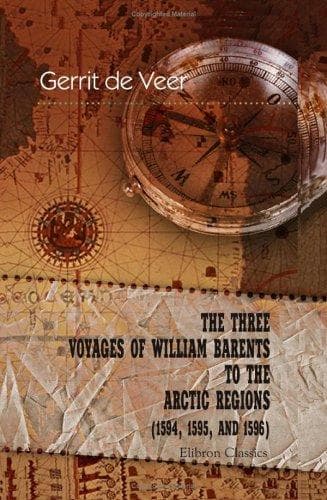
The Three Voyages of William Barents to the Arctic Regions (1594, 1595, and 1596)Veer, Gerrit de
History
The Three Voyages of William Barents to the Arctic Regions (1594, 1595, and 1596)
Veer, Gerrit de
Barentsz, Willem, approximately 1550-1597; Northeast Passage
“7. Fragments of a chest with metal handle belonging to it, besides
four other pieces of iron. An iron box made to fit within the
chest, in order therein to deposit valuables. All these things were
half crumbled away.
“8. The iron cover of the chest (spoken of in No. 7), with
intricate lock-work.
“9. An iron crow-bar, bent in the middle, at the lower end a point,
the upper end formed like the tail of a swallow. The part which
opens out is worn in a circular shape, having in all probability
served as a rest for the axis of a spit.
“10. The sieve of a copper scummer.
“11. A tin plate.
“12. An iron bar in two pieces. This bar was sawn across at
Hammerfest, as it was presumed to be a gun-barrel.
“13. Iron striker or sledge-hammer; the handle is broken.
“14. A borer or auger, with auger-bit. Such an auger is represented
in the illustration, ‘How made ready to sail back to Holland’.
“15. A ditto, one with larger auger-bit.
“16. Three gauges, without handles.
“17. A large chisel, with a wooden handle.
“18. An adze, of which the handle was broken.
“19. A caulking-iron.
“20. A borer, with the handle broken, and two other boring irons.
“21. Seven iron files, of different dimensions.
“22. A stone to whet tools.
“23. Two iron pairs of compasses.
“24. A broken pocket-knife or cutlass, with horn handle.
“25. A copper tap of a wine or beer cask. Excellently preserved.
“26. A wooden siphon of a beer or vinegar cask.
“27. A wooden trencher, painted red.
“28. An old Dutch earthenware jar, in which there was still a
little grease. (See a similar jug in the illustration, ‘How we were
wrecked, and with great danger had to betake ourselves to the
ice’.)
“29. A tin tankard, with lid and handle. Decayed.
“30. The lower half of another tankard.
“31. Three tin spoons, of which one is broken. Of the form used in
the sixteenth and seventeenth centuries.
“32. The inner works of a lock.
“33. A ditto, larger one, with a part of the key.
“34. An iron weight, of 8 lbs.
“35. A padlock.
“36. Two leathern shoes or slippers. These shoes are too small for
a full-grown man. They must consequently have belonged to the
ship’s boy, of whom there is mention in the journal of De Veer, on
the 19th of October, 1596.
Public-domain text, read in full here on John Shaqi.
Reviews
Reviews
No reviews yet
Be the first to share your thoughts on this work.
Elsewhere in the archive
Join the Discussion
Join the discussion
Sign in to leave a comment or review.
Sign InorCreate an account