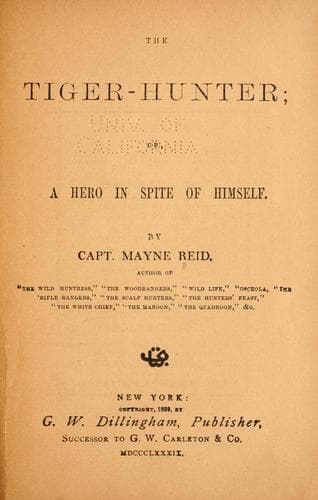
Mexico -- History -- Wars of Independence, 1810-1821 -- Fiction
By little and little the eastern horizon exhibited a brighter dawn; and
the clouds that floated over the heads of those people so piously bent,
becoming tinged with purple, announced the rising of the sun.
It will be remembered that, at the council of war, the Spanish general
had decided not to make his attack till after the hour of noon. No
preparations, therefore, had as yet been made in the Royalist camp.
As Bonavia was still ignorant both of the proximity of Morelos and
Trujano's intention to make a sortie, the double attack was likely to
fall upon the Spanish camp with the suddenness of a thunderbolt.
The Spanish army was divided into three brigades, that might almost be
said to occupy three separate encampments. The first, commanded by
Regules, held position nearest to the walls of the town. The second,
under the immediate orders of Bonavia himself, occupied the centre;
while the third, in command of Caldelas, formed the rearguard.
According to this disposition, Trujano, in sallying from the town, would
come immediately into collision with the brigade of Regules; while
Morelos, approaching from the mountains, would direct his attack against
that of Caldelas. In this case, Bonavia, from the centre, could march
to the assistance of whichever of his two brigadiers should stand most
in need of it.
The Colonel Tres-Villas was second in command in the brigade of
Caldelas, and his tent was of course in the rear.
During the night he had slept but little.
Sometimes during a storm the thick mantle of clouds which covers the sky
breaks suddenly apart, disclosing an almost imperceptible portion of the
azure canopy. Only for a moment the blue spot is visible, after which
the dull vapoury mass closes over it, and again hides it from view.
Such was the ray of hope that had lately shone into the heart of Don
Rafael. His habitual melancholy had assumed the ascendant, and the
cloud had returned.
The man who passionately loves, and he who scarce loves at all, are
equally unable to tell when their love is reciprocated. His violent
passion blinds the judgment of the one; while indifference renders the
other inattentive. Neither is capable of perceiving the tokens of love
which he may have inspired, and which pass unnoticed before his eyes.
In the former situation was Don Rafael. Despite the proofs which
Gertrudis had given him, his thought was, _not that he was no longer
loved, but that he had never been loved at all_! He, who had almost
sacrificed his love to his pride, could not perceive that the pride of a
woman may also have its days of revolt against her heart. Hence arose
the profound discouragement which had taken possession of him, and
extinguished the ray of hope that had gleamed for a moment in his
breast.
Public-domain text, read in full here on John Shaqi.
Reviews
Reviews
No reviews yet
Be the first to share your thoughts on this work.
Elsewhere in the archive
Join the Discussion
Join the discussion
Sign in to leave a comment or review.
Sign InorCreate an account