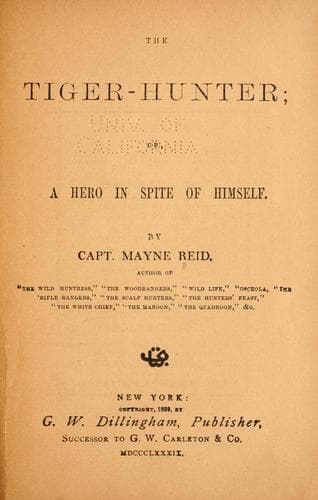
Mexico -- History -- Wars of Independence, 1810-1821 -- Fiction
"What better fate could I have wished for her? She has escaped
dishonour at the hands of these pitiless brigands, and I am about to die
myself. Yes, friend! death is now sweeter to me than life: for it will
bring me to her whom I love more than myself."
And like those who, calmly dying, arrange everything as if for some
ordinary ceremonial, the young man laid his head upon the pillow; and
then stretching out his hands, composed the coverlet around him--leaving
it open at one side, as if for the funereal couch of her whom he would
never see more.
Don Cornelio, turning away from the painful spectacle, advanced towards
the lake, making signs for Costal to follow him.
"Come this way," he said, "and you shall see how much truth there is in
your pagan superstitions."
Costal made no objection: for he had already begun to mistrust the
evidence of his own senses; and both proceeded together towards the spot
where the torch-bearers had halted.
A white robe, torn by the thorns of the thicket, stained with blood, and
bedraggled by the greenish scum of the water, enveloped the lifeless
form of the young wife, whom the Indians had already deposited upon a
couch of reeds. Some green leaves that hung over her head appeared to
compose her last _parure_.
"She is beautiful as the Syren of the dishevelled hair," said Costal, as
he stood gazing upon the prostrate form, "beautiful as Matlacuezc! Poor
Don Mariano!" continued he, recognising the daughter of his old master,
"he is far from suspecting that he has now only one child!"
Saying this the Indian walked away from the spot, his head drooping
forward over his breast, and apparently absorbed in painful meditation.
"Well," said Don Cornelio, who had followed him, "do you still believe
that you saw the spouse of your god Tlaloc?"
"I believe what my fathers have taught me to believe," replied Costal,
in a tone of discouragement. "I believe that the descendant of the
Caciques of Tehuantepec is not destined to restore the ancient glories
of his race. Tlaloc, who dwells here, has forbidden it."
And saying this the Zapoteque relapsed into silence, and walked on with
an air of gloomy abstraction that seemed to forbid all further
conversation on the subject of his mythological creed.
CHAPTER EIGHTY ONE.
TWO HAPPY HEARTS.
We have arrived at the final scene of our drama. The shores of the Lake
Ostuta, which in so short a space of time had witnessed so many stirring
events, are once more to relapse into their gloomy and mournful silence.
Already Don Cornelio and his two companions have disappeared from the
spot, and taken the road for Oajaca.
The funeral cortege is moving off towards the hacienda of San Carlos--
the Indians who carry the bier marching in solemn silence. On that bier
two corpses are laid side by side--the Spaniard Don Fernando de Lacarra
by the side of his youthful wife.
Public-domain text, read in full here on John Shaqi.
Reviews
Reviews
No reviews yet
Be the first to share your thoughts on this work.
Elsewhere in the archive
Join the Discussion
Join the discussion
Sign in to leave a comment or review.
Sign InorCreate an account