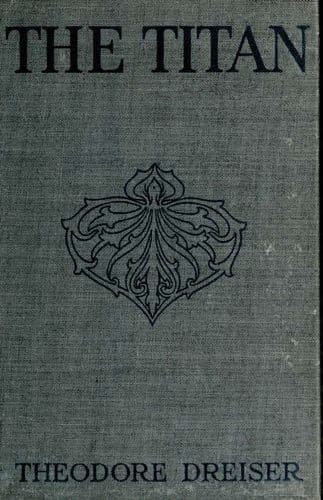
Capitalists and financiers -- Fiction; Chicago (Ill.) -- Fiction; Psychological fiction
Cowperwood gained his first real impression of Stephanie at the Garrick
Players, where he went with Aileen once to witness a performance of
“Elektra.” He liked Stephanie particularly in this part, and thought
her beautiful. One evening not long afterward he noticed her in his own
home looking at his jades, particularly a row of bracelets and
ear-rings. He liked the rhythmic outline of her body, which reminded
him of a letter S in motion. Quite suddenly it came over him that she
was a remarkable girl—very—destined, perhaps, to some significant
future. At the same time Stephanie was thinking of him.
“Do you find them interesting?” he asked, stopping beside her.
“I think they’re wonderful. Those dark-greens, and that pale, fatty
white! I can see how beautiful they would be in a Chinese setting. I
have always wished we could find a Chinese or Japanese play to produce
sometime.”
“Yes, with your black hair those ear-rings would look well,” said
Cowperwood.
He had never deigned to comment on a feature of hers before. She turned
her dark, brown-black eyes on him—velvety eyes with a kind of black
glow in them—and now he noticed how truly fine they were, and how nice
were her hands—brown almost as a Malay’s.
He said nothing more; but the next day an unlabeled box was delivered
to Stephanie at her home containing a pair of jade ear-rings, a
bracelet, and a brooch with Chinese characters intagliated. Stephanie
was beside herself with delight. She gathered them up in her hands and
kissed them, fastening the ear-rings in her ears and adjusting the
bracelet and ring. Despite her experience with her friends and
relatives, her stage associates, and her paramours, she was still a
little unschooled in the world. Her heart was essentially poetic and
innocent. No one had ever given her much of anything—not even her
parents. Her allowance thus far in life had been a pitiful six dollars
a week outside of her clothing. As she surveyed these pretty things in
the privacy of her room she wondered oddly whether Cowperwood was
growing to like her. Would such a strong, hard business man be
interested in her? She had heard her father say he was becoming very
rich. Was she a great actress, as some said she was, and would strong,
able types of men like Cowperwood take to her—eventually? She had heard
of Rachel, of Nell Gwynne, of the divine Sarah and her loves. She took
the precious gifts and locked them in a black-iron box which was sacred
to her trinkets and her secrets.
The mere acceptance of these things in silence was sufficient
indication to Cowperwood that she was of a friendly turn of mind. He
waited patiently until one day a letter came to his office—not his
house—addressed, “Frank Algernon Cowperwood, Personal.” It was written
in a small, neat, careful hand, almost printed.
Public-domain text, read in full here on John Shaqi.
Reviews
Reviews
No reviews yet
Be the first to share your thoughts on this work.
Elsewhere in the archive
Join the Discussion
Join the discussion
Sign in to leave a comment or review.
Sign InorCreate an account