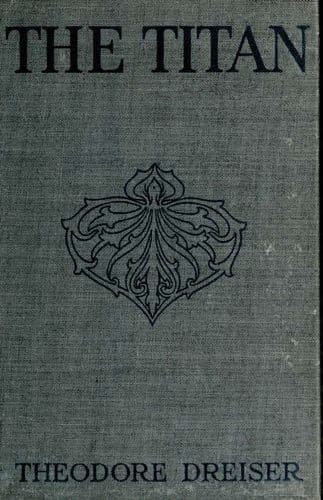
Capitalists and financiers -- Fiction; Chicago (Ill.) -- Fiction; Psychological fiction
not practical, and still passionate and inclined to dissipation.
However, the aimless, fatuous going to pieces of Ira George Carter, the
looming pathos of the future of the children, and a growing sense of
affection and responsibility had finally sobered her. The lure of love
and life had not entirely disappeared, but her chance of sipping at
those crystal founts had grown sadly slender. A woman of thirty-eight
and still possessing some beauty, she was not content to eat the husks
provided for the unworthy. Her gorge rose at the thought of that
neglected state into which the pariahs of society fall and on which the
inexperienced so cheerfully comment. Neglected by her own set, shunned
by the respectable, her fortune quite gone, she was nevertheless
determined that she would not be a back-street seamstress or a
pensioner upon the bounty of quondam friends. By insensible degrees
came first unhallowed relationships through friendship and passing
passion, then a curious intermediate state between the high world of
fashion and the half world of harlotry, until, finally, in Louisville,
she had become, not openly, but actually, the mistress of a house of
ill repute. Men who knew how these things were done, and who were
consulting their own convenience far more than her welfare, suggested
the advisability of it. Three or four friends like Colonel Gillis
wished rooms—convenient place in which to loaf, gamble, and bring their
women. Hattie Starr was her name now, and as such she had even become
known in a vague way to the police—but only vaguely—as a woman whose
home was suspiciously gay on occasions.
Cowperwood, with his appetite for the wonders of life, his appreciation
of the dramas which produce either failure or success, could not help
being interested in this spoiled woman who was sailing so vaguely the
seas of chance. Colonel Gillis once said that with some strong man to
back her, Nannie Fleming could be put back into society. She had a
pleasant appeal—she and her two children, of whom she never spoke.
After a few visits to her home Cowperwood spent hours talking with Mrs.
Carter whenever he was in Louisville. On one occasion, as they were
entering her boudoir, she picked up a photograph of her daughter from
the dresser and dropped it into a drawer. Cowperwood had never seen
this picture before. It was that of a girl of fifteen or sixteen, of
whom he obtained but the most fleeting glance. Yet, with that instinct
for the essential and vital which invariably possessed him, he gained a
keen impression of it. It was of a delicately haggard child with a
marvelously agreeable smile, a fine, high-poised head upon a thin neck,
and an air of bored superiority. Combined with this was a touch of
weariness about the eyelids which drooped in a lofty way. Cowperwood
was fascinated. Because of the daughter he professed an interest in the
mother, which he really did not feel.
Public-domain text, read in full here on John Shaqi.
Reviews
Reviews
No reviews yet
Be the first to share your thoughts on this work.
Elsewhere in the archive
Join the Discussion
Join the discussion
Sign in to leave a comment or review.
Sign InorCreate an account