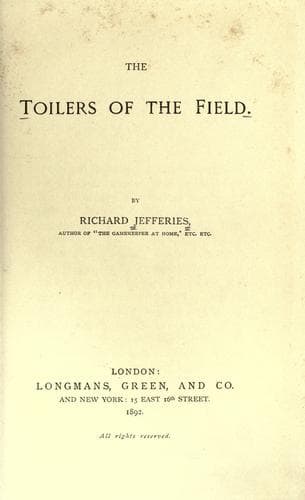
Agricultural laborers -- England; Country life -- England
In the hollow at Long Ditton I had the delight, a day or two since, to
see a kingfisher. There is a quiet lane, and at the bottom, in a valley,
two ponds, one in enclosed grounds, the other in a meadow opposite.
Standing there a minute to see if there was a martin among the birds
with which the pond in the grounds is thickly covered, something came
shooting straight towards me, and swerving only a yard or two to pass
me, a kingfisher went by. His blue wings, his ruddy front, the white
streak beside his neck, and long bill, were all visible for a moment;
then he was away straight over the meadow, the directness of his course
enabling it to be followed for some time till he cleared the distant
hedge, probably going to visit his nest. Kingfishers, though living by
the stream, often build a good way from water. The months have
lengthened into years since I saw one here before, sitting on the trunk
of a willow which bends over the pond in the mead. The tree rises out of
the water and is partly in it; it is hung with moss, and the kingfisher
was on the trunk within a foot or so of the surface. After that there
came severe winters, and till now I did not see another here. So that
the bird came upon me unexpectedly out from the shadow of the trees that
overhang the water, past me, and on into the sunshine over the
buttercups and sorrel of the field.
This hollow at Long Ditton is the very place of singing birds; never was
such a place for singing--the valley is full of music. In the oaks
blackbirds whistle. You do not often see them; they are concealed by the
thick foliage up on high, for they seek the top branches, which are more
leafy; but once now and then they quietly flutter across to another
perch. The blackbird's whistle is very human, like a human being playing
the flute; an uncertain player, now drawing forth a bar of a beautiful
melody and then losing it again. He does not know what quiver or what
turn his note will take before it ends; the note leads him and completes
itself. It is a song which strives to express the singer's keen delight,
the singer's exquisite appreciation of the loveliness of the days; the
golden glory of the meadow, the light, the luxurious shadows, the
indolent clouds reclining on their azure couch. Such thoughts can only
be expressed in fragments, like a sculptor's chips thrown off as the
inspiration seizes him, not mechanically sawn to a set line. Now and
again the blackbird feels the beauty of the time, the large white daisy
stars, the grass with yellow-dusted tips, the air which comes so softly
unperceived by any precedent rustle of the hedge, the water which runs
slower, held awhile by rootlet, flag, and forget-me-not. He feels the
beauty of the time and he must say it. His notes come like wild flowers,
not sown in order. The sunshine opens and shuts the stops of his
instrument. There is not an oak without a blackbird, and there are
others afar off in the hedges. The thrushes sing louder here than
Public-domain text, read in full here on John Shaqi.
Reviews
Reviews
No reviews yet
Be the first to share your thoughts on this work.
Elsewhere in the archive
Join the Discussion
Join the discussion
Sign in to leave a comment or review.
Sign InorCreate an account