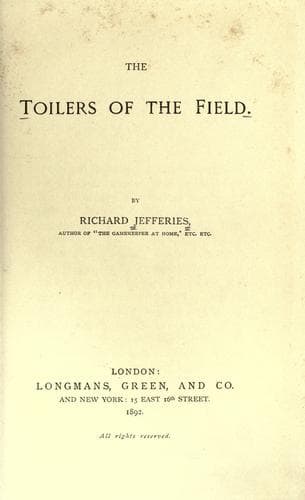
Agricultural laborers -- England; Country life -- England
been known to remain so long, generation after generation, in these
wretched hovels, that at last the lord of the manor, having neglected to
claim quit-rent, they can defy him, and claim them as their own
property, and there they stick, eyesores and blots, the fungi of the
land. The cottages erected by farmers or by landlords are now, one and
all, fit and proper habitations for human beings; and I verily believe
it would be impossible throughout the length and breadth of Wiltshire to
find a single bad cottage on any large estate, so well and so thoroughly
have the landed proprietors done their work. On all farms gardens are
attached to the cottages, in many instances very large, and always
sufficient to produce enough vegetables for the resident. In villages
the allotment system has been greatly extended of late years, and has
been found most beneficial, both to owners and tenants. As a rule the
allotments are let at a rate which may be taken as L4 per annum--a sum
which pays the landlord very well, and enables the labourer to
remunerate himself. In one village which came under my observation the
clergyman of the parish has turned a portion of his glebe land into
allotments--a most excellent and noble example, which cannot be too
widely followed or too much extolled. He is thus enabled to benefit
almost every one of his poor parishioners, and yet without destroying
that sense of independence which is the great characteristic of a true
Englishman. He has issued a book of rules and conditions under which
these allotments are held, and he thus places a strong check upon
drunkenness and dissolute habits, indulgence in which is a sure way to
lose the portions of ground. There is scarcely an end to the benefits of
the allotment system. In villages there cannot be extensive gardens, and
the allotments supply their place. The extra produce above that which
supplies the table and pays the rent is easily disposed of in the next
town, and places many additional comforts in the labourer's reach. The
refuse goes to help support and fatten the labourer's pig, which brings
him in profit enough to pay the rent of his cottage, and the pig, in
turn, manures the allotment. Some towns have large common lands, held
under certain conditions; such are Malmesbury, with 500 acres, and
Tetbury (the common land of which extends two miles), both these being
arable, &c. These are not exactly in the use of labourers, but they are
in the hands of a class to which the labourer often rises. Many
labourers have fruit-trees in their gardens, which, in some seasons,
prove very profitable. In the present year, to my knowledge, a labourer
sold L4 worth of apples; and another made L3, 10s. off the produce of
one pear-tree, pears being scarce.
Public-domain text, read in full here on John Shaqi.
Reviews
Reviews
No reviews yet
Be the first to share your thoughts on this work.
Elsewhere in the archive
Join the Discussion
Join the discussion
Sign in to leave a comment or review.
Sign InorCreate an account