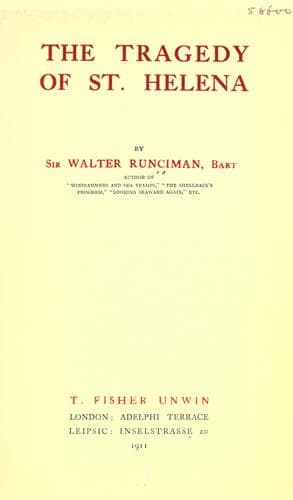
The Tragedy of St. HelenaRunciman, Walter Runciman, Baron
History
The Tragedy of St. Helena
Runciman, Walter Runciman, Baron
Napoleon I, Emperor of the French, 1769-1821 -- Captivity, 1815-1821
This decision was regarded by Josephine as highly satisfactory to
herself. She made no fuss about it, but was greatly overjoyed at the
prospect of the effect it would have on Napoleon, and for a time no
more was openly heard of divorce; but the venom was insidiously eating
its way to that end all the same, and as he grew in power, so did the
conspiracy develop. His own family were eager that she should be put
away, but there were influences more powerful than that of Madame Mere
and her sons and daughters. Talleyrand and Fouche being the High
Commissioners who founded the direct hereditary idea, they
persistently worried him with the plea that the State claimed that he
should make the sacrifice. They knew that this was the strongest and
most effective reason they could put forward to a man who would have
given his soul in the service of his country.
The birth of Madame Eleonore Denuelle's son Leon on December 29, 1806,
made a great impression on the Emperor's mind. It was well known that
he was the father of the child, and now that there was no doubt as to
the possibility of him having an heir, it was only to be expected
that the advocates of divorce would press their claim that an
alliance should be made with one of the powerful ruling families. The
advantages to France would be inestimable, and would it not establish
himself and his dynasty more firmly on the throne? It is not unlikely
that Napoleon pondered over the great possibilities of such a
marriage, but he could not bring himself to the thought of divorcing
the woman he still loved. He went so far as to seek Josephine's
support in the plan of making his natural son his heir, and Masson
says that in support of his desire he vigorously used "precedents and
invented justifications." Happily he did not stretch the law of
hereditary succession further than this.
Leon, when he grew up, became a great source of trouble to all those
with whom he was connected. His features and physical make up had a
marked resemblance to his father's, but his mind was erratic. He had
inherited none of the steady, sane genius of the Emperor, though but
for a freak of nature which gave him a mental twist, he would have
been as near his prototype as may be. He was always full of great
schemes, which in the hands of a normally constituted person would
have been fashioned into public usefulness.
Masson gives a vivid and somewhat categorical account of his
predilections, which were "gambling, duels, politics, writing
pamphlets, the conception of colossal canal, railway, and commercial
undertakings that never got far beyond the initial and rocky mental
stage." He was one of the chief mourners when his father's remains
were brought to Paris from St. Helena in 1840, and in 1848 aspired to
the Presidency of the Republic, which fell to the lot of his cousin
Louis Napoleon, whose life he desired to take, but who, with great
generosity, gave him a pension and paid the legacy left him by
Napoleon. He died in 1881.
Public-domain text, read in full here on John Shaqi.
Reviews
Reviews
No reviews yet
Be the first to share your thoughts on this work.
Elsewhere in the archive
Join the Discussion
Join the discussion
Sign in to leave a comment or review.
Sign InorCreate an account