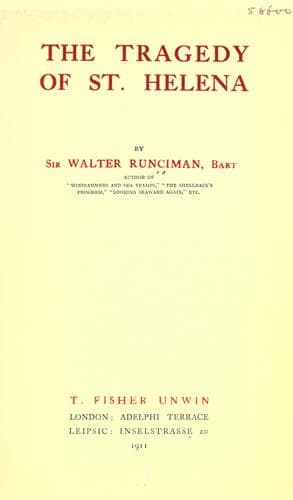
The Tragedy of St. HelenaRunciman, Walter Runciman, Baron
History
The Tragedy of St. Helena
Runciman, Walter Runciman, Baron
Napoleon I, Emperor of the French, 1769-1821 -- Captivity, 1815-1821
Napoleon was kept advised, during his stay at Elba, of their designs
on the liberty they had graciously (?) given him (with a pension that
was designedly withheld), and, acting on certain specific information,
he promptly developed one of his most brilliant achievements--the
sudden landing in France, his triumphal march to Paris, and the
resultant flight of the Bourbons at his unexpected approach at the
head of an enthusiastic army.
The campaign which followed--ending with the Battle of
Waterloo--enabled the Allies, after his defeat, to satisfy the
cravings of their savage instincts by carrying out their plan as
mentioned above and sending him to martyrdom.
But one of their most brutal acts was in refusing the request that his
wife and child should accompany him to Elba. These are the ultimate
"better terms" that Josephine is said to have secured by coquetting
with Alexander of Russia!
She revelled in grasping at every fragment of wreckage that would be
of advantage to herself and her family, and Alexander's crafty
friendship unquestionably gave her opportunities to indulge unchecked
in complaints of her grievances against the man who had been so foully
betrayed. Her mania for the distribution of confidences of the most
sacred character was only equalled by her capacity for intriguing and
piling up debts, and these attributes never forsook her at any time.
Josephine's moral qualities cannot be accurately judged by her
frequent outpourings of admiration and affection for Napoleon to
Eugene and Hortense. In the letters to each which are extant, she
declares it would be impossible for anyone to be kinder, more amiable,
or considerate than he has always been, and even after the divorce she
writes that if she loved him less sincerely, he could not show more
anxiety to mitigate anything that might be painful to her.
But notwithstanding these declarations, she never failed to gratify
her insatiable love of pouring forth to his most inveterate enemies
faults and failings that her constitutional moral obliquity indicated
he had. It is not an unfair assumption, therefore, that their
Majesties and others had conveyed to them in handfuls (unwittingly
perhaps) much that was valuable to their pernicious purpose while they
were being entertained at Malmaison. It has been said that it was her
intention to be presented to the Bourbon King, and though we would
fain believe her to be incapable of such perfidy, it is quite in
keeping with the by-ways of her complex character, more especially as
Eugene had paid him a visit. The promises of the sovereigns that the
interests of herself and children would be protected became less
reassuring as the few days that were left to her went on. At last she
realised they were mere silken verbiage, and gave way to despair.
This, and the anxiety of entertaining her royal guests, accentuated
the illness she had contracted. Alexander paid his first visit on May
14th, and she died of quinsy or diphtheria on May 29, 1814.
Public-domain text, read in full here on John Shaqi.
Reviews
Reviews
No reviews yet
Be the first to share your thoughts on this work.
Elsewhere in the archive
Join the Discussion
Join the discussion
Sign in to leave a comment or review.
Sign InorCreate an account