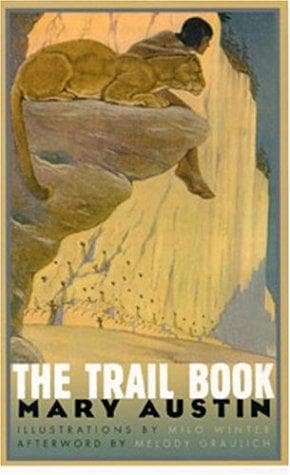
American Museum of Natural History -- Fiction; Indians of North America -- Fiction; Nature stories, American; Western stories
The Condor nodded, turning over the Zuni words in his mind for just the
right phrase. "Understanding of all her former states came to her with
the years. There was nothing she dreaded so much as being forced out of
this life into the dust and whirl of Becoming. That is one reason why
she feared and distrusted the Spanish missionaries when they came, as
they did about that time.
"One of her husband's two hearts pulled very strongly toward the
religion of the Spanish Padres. He was of the first that were baptized
by Father Letrado, and served the altar. He was also the first of those
upon whose mind the Padre began to work to persuade him that in taking
the new religion he must wholly give up the old.
"At the end of that trail, a day's journey," said the Condor, indicating
the narrow foot-tread in the sand, which showed from tree to tree of the
dark junipers, and seemed to turn and disappear at every one, "lies the
valley of Shiwina, which is Zuni.
"It is a narrow valley, watered by a muddy river. Red walls of mesas
shut it in above the dark wood. To the north lies Thunder Mountain,
wall-sided and menacing. Dust devils rise up from the plains and veil
the crags. In the winter there are snows. In the summer great clouds
gather over Shiwina and grow dark with rain. White corn tassels are
waving, blue butterfly maidens flit among the blossoming beans.
"Day and night at midsummer, hardly the priests have their rattles out
of their hands. You hear them calling from the house-tops, and the beat
of bare feet on the dancing places. But the summer after Father Letrado
built his chapel of the Immaculate Virgin at Halona and the chapel and
parish house of the Immaculate Conception at Hawikuh, he set his face
against the Rain Dance, and especially against the Priests of the Rain.
Witchcraft and sorcery he called it, and in Zuni to be accused of
witchcraft is death.
"The people did not know what to do. They prayed secretly where they
could. The Priests of the Rain went on with their preparations, and the
soldiers of Father Letrado--for he had a small detachment with
him--broke up the dance and profaned the sacred places. Those were hard
days for Ho-tai the Two-Hearted. The gods of the strangers were strong
gods, he said, let the people wait and see what they could do. The white
men had strong Medicine in their guns and their iron shirts and their
long-tailed, smoke-breathing beasts. They did not work as other gods.
Even if there was no rain, the white gods might have another way to save
the people.
"These were the things Father Letrado taught him to say, and the
daughter of the Chief Priest of the Bow feared that his heart would be
quite pulled away from the people of Zuni. Then she went to her father
the Chief Priest, who was also the keeper of the secret of the Holy
Places of the Sun, and neared the dividing of the ways of life.
Public-domain text, read in full here on John Shaqi.
Reviews
Reviews
No reviews yet
Be the first to share your thoughts on this work.
Elsewhere in the archive
Join the Discussion
Join the discussion
Sign in to leave a comment or review.
Sign InorCreate an account