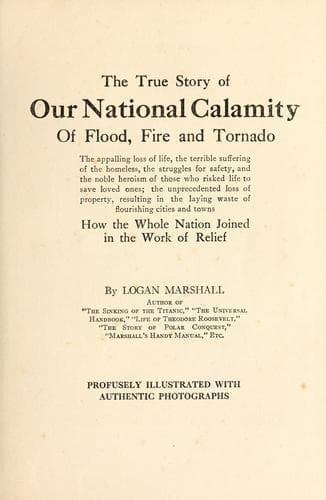
The True Story of Our National Calamity of Flood, Fire and TornadoMarshall, Logan
History
The True Story of Our National Calamity of Flood, Fire and Tornado
Marshall, Logan
Floods -- Ohio River Valley; Omaha (Neb.) -- Tornado, 1913
In Central Pennsylvania, especially along the Susquehanna, the flood
gripped many towns. At Shamokin mountain streams overflowed their banks,
and in some instances water flowed down mine breaches and found its way
to the lower levels of collieries. Mine pumps were run to their
greatest capacity to prevent inundations. The Shamokin Creek, in
Shamokin Valley, overflowed its banks in the lowlands and spread over
acres of ground on either side of the creek channel.
COLUMBIA AND MARIETTA FLOODED
More than three inches of water fell at Columbia in a period of
twenty-four hours. All the streams overflowed and much damage was done.
Trains on the Columbia branch of the Pennsylvania Railroad ran through
eighteen inches of water. The storm was accompanied by high winds, which
unroofed scores of buildings.
At Marietta, after a storm reported as the worst in many years, the
flood situation was grave. The river rose high, fields were flooded and
residents on Front Street were obliged to move to second stories. Two
men upset in a boat along the York County shore while after ducks were
drowned.
DESTRUCTION AND DAMAGE IN MINING TOWNS
Many of the mining towns in Pennsylvania were distressed by
unprecedented floods. At Scranton the Lackawanna River overflowed its
banks in various places. Richmond No. 1 and No. 2 collieries and the
Delaware and Hudson "slope" colliery in North Scranton were compelled to
shut down by reason of the water flooding the engine rooms. The Ontario
and Western tracks at Providence and the Delaware and Hudson tracks at
Dickson City were washed out. Water surrounded the Frisbie and the Bliss
silk mills in Dickson City and the girls were marooned for the night.
Six hundred people living on "Hungarian Flats," in the northern end of
the city, became panic-stricken when water broke through the streets,
and, taking their cattle and household goods, they fled to the hills at
Throop.
At Wilkes-Barre the Susquehanna reached the flood stage. The water went
over the lowlands on the west side and Wilkes-Barre was cut off from
many of its suburban towns, all traffic being stopped. The towns of
Edwardsville, Kingston, Westmoor and West Nanticoke were partly under
water. Five hundred families were driven from their homes and forced to
seek safety. The water rose so rapidly that it was necessary to rescue
women and children in rowboats. Considerable damage was done to
property, but there was no loss of life.
In Westmoor, Edwardsville and West Nanticoke the water reached the first
floors of the buildings. Families were compelled to depart and leave
their furnishings to be damaged by the water.
As a result of heavy rains the water rose high in many of the mines of
the Hazleton region. Railroad men were warned to be on guard for
washouts.
The Beaver Brook and Hazle Mountain mines closed on account of high
water. The mules were removed from the Ebervale, Harleigh and Beaver
Brook workings.
Public-domain text, read in full here on John Shaqi.
Reviews
Reviews
No reviews yet
Be the first to share your thoughts on this work.
Elsewhere in the archive
Join the Discussion
Join the discussion
Sign in to leave a comment or review.
Sign InorCreate an account