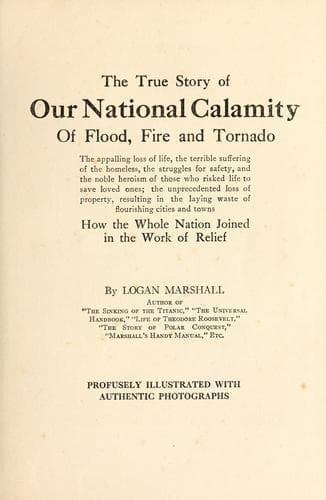
The True Story of Our National Calamity of Flood, Fire and TornadoMarshall, Logan
History
The True Story of Our National Calamity of Flood, Fire and Tornado
Marshall, Logan
Floods -- Ohio River Valley; Omaha (Neb.) -- Tornado, 1913
As an illustration of how the railroads spend money in such an
emergency, it may be said that the Pennsylvania sent one hundred and
fifty expert bridge builders out West from New York in one day soon
after the flood. These men received record wages; they traveled in
sleepers, with special dining cars. The company was sending
steam-shovels and pile-drivers on limited trains and a first-class
laborer could get a private compartment quicker than could a financier.
"There will be improvements in railroading through all the districts
every day from now on, but there will not be anything like a restoration
of former conditions for months," said one railroad official. "It takes
time to rebuild steel bridges, especially as the big steel plants have
been experiencing a little trouble of their own."
FLOOD PLAYED HAVOC WITH MAILS
Storm, flood and fire in the Middle West played havoc with the United
States mails. Postmaster-General Burleson announced on March 26th that
the destruction wrought by the floods in Ohio and Indiana was so serious
that it would be ten or twelve days before a regular mail service could
be resumed with the remote districts.
Reports showed that never before in the history of the service had there
been such a serious interruption to the mails on account of floods.
There was practically no local service on the railroads in the
territory bounded by Cleveland, Toledo, Columbus, Cincinnati,
Indianapolis, Terre Haute and the Ohio River.
Mails to New York from points in Kentucky and Tennessee, from Pittsburgh
and Cincinnati, Ohio, and all points south of the Ohio River came by way
of Washington and were from five to seven hours late. The Arkansas and
Oklahoma mails traveled by way of Chattanooga and Memphis.
The representatives in the field were directed to be in constant
communication with the department at Washington and to make every effort
to supply the people in the flood districts with mail as rapidly as
arrangements could be completed. Mails for distant points which
regularly passed through the flooded sections were detoured north and
south, resulting in unavoidable delay.
GENERAL PROSTRATION OF TELEGRAPH AND TELEPHONE WIRES
Never before in the history of the United States was there such a
general prostration of telegraph and telephone wires as during the great
flood. Chicago was "lost" to the East for part of a day, and it was
found impossible to reach that city via the South. Throughout eastern
Ohio service was paralyzed, and such few wires as could be obtained were
flickering and often going down.
Public-domain text, read in full here on John Shaqi.
Reviews
Reviews
No reviews yet
Be the first to share your thoughts on this work.
Elsewhere in the archive
Join the Discussion
Join the discussion
Sign in to leave a comment or review.
Sign InorCreate an account