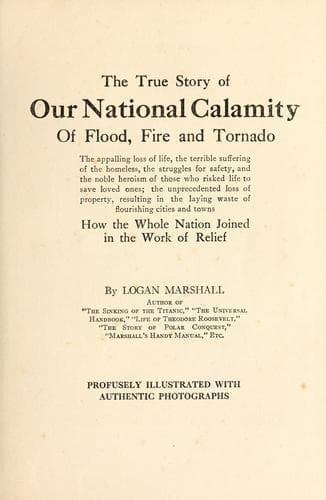
The True Story of Our National Calamity of Flood, Fire and TornadoMarshall, Logan
History
The True Story of Our National Calamity of Flood, Fire and Tornado
Marshall, Logan
Floods -- Ohio River Valley; Omaha (Neb.) -- Tornado, 1913
The President was in his office all day Wednesday, March 26th, in close
touch with the situation. He apprised the chairmen of the Senate and
House appropriations committees that the government was going ahead with
emergency expenditures on the assumption that Congress would back up the
administration later. Both promised hearty support, and orders went out
on every side for a gigantic work of relief.
Major P. C. Fauntleroy was sent to Columbus to handle the medical
supplies. Nine medical officers and fifty-four hospital corps men went
from the Department of the East carrying a big supply of surgical
dressings, anti-typhoid prophylactics and the complete "reserve medical
supply" comprising hundreds of drugs sufficient to treat 20,000 patients
for one month. Precautions against the spread of disease were to be
handled by sanitation experts.
Life-saving crews were ordered from Louisville to Dayton and from
Lorain, Ohio, to Delaware, Ohio, and the public health service
distributed its agents over the afflicted districts.
SUPPLIES ON THE WAY
By Friday more than double the apparently necessary medical supplies for
the flood sufferers were on their way to Ohio and Indiana, a full quota
of supplies having been started from the army supply warehouses at St.
Louis and a second consignment from Washington.
From the naval stores a huge consignment of wearing apparel and bedding
for the sufferers was sent to Columbus. These supplies were started from
the naval stores at New York. Paymaster-General Cowie made the
arrangements under orders from Secretary of the Navy Daniels. The
shipment included 12,000 blankets, 7,000 watch caps, 50,000 pairs of
light weight drawers, 80,000 light weight undershirts, 30,000 heavy
weight drawers, 30,000 heavy weight shirts, 4,200 navy jerseys, 15,000
khaki jumpers, 24,000 pairs of dungaree trousers, 8,000 overcoats,
24,000 pairs of shoes and 15,000 pairs of woolen socks.
In addition to the clothing supply the Navy sent also 300,000 rations on
the way to Columbus and Dayton. Paymaster Nesbit and Paymaster's Clerk
Conell were in charge of the distribution. Assistant Secretary Roosevelt
supplied them with $25,000 in currency with full authority to expend it
for such supplies and services as they might find necessary.
For a time President Wilson considered going himself to the flood
districts; but reports from Secretary Garrison and others were so
encouraging that he decided it was unnecessary.
"Refreshed by the tears of the American people, Ohio stands ready from
today to meet the crisis alone," wrote Governor Cox of Ohio on March
31st.
After seeing the situation well in hand in Dayton, Secretary Garrison
returned to Cincinnati and then proceeded to Columbus. By April 2d he
was able to return to Washington.
AMERICAN RED CROSS TO THE RESCUE
Public-domain text, read in full here on John Shaqi.
Reviews
Reviews
No reviews yet
Be the first to share your thoughts on this work.
Elsewhere in the archive
Join the Discussion
Join the discussion
Sign in to leave a comment or review.
Sign InorCreate an account