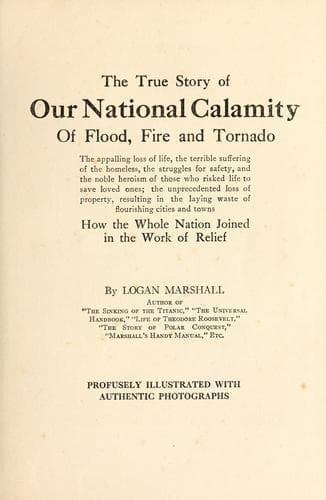
The True Story of Our National Calamity of Flood, Fire and TornadoMarshall, Logan
History
The True Story of Our National Calamity of Flood, Fire and Tornado
Marshall, Logan
Floods -- Ohio River Valley; Omaha (Neb.) -- Tornado, 1913
"The Mississippi River in flood," says a recent writer, "takes
everything with it. To watch the endless procession which the swift
current carries by is to see all the properties of tragedies. The
Mississippi in flood is the despoiler of homes. Houses come floating
down the stream, outbuildings, furniture and myriads of smaller things,
tossed by waves in the 'runs' or sailing on serenely in the broader
stretches. Great trees go by. They are evidence that the Mississippi has
asserted its majesty somewhere and has cut a new channel to please
itself, eating away bank, growth, and all. Carcasses of cows and horses
and dogs float down the stream, carrying a pair of buzzards, those
scavengers who have so much work to do after the floods have receded. It
is a terrible and a melancholy sight."
THE FLOOD OF 1912
In April and May, 1912, the Mississippi reached a height never before
equaled, and the great river went tearing through levee after levee on
its resolute course to the sea. The river reached a maximum width of
sixty miles, killed 1,000 persons, rendered 30,000 homeless, and caused
damage to the amount of $50,000,000.
By April 2d, Columbus, Missouri, was buried under fifteen feet of water,
and in some parts of the town residences were wholly submerged. New
Madrid was not much better off, and Hickman, Kentucky, looked like a
small city of Venice. President Taft sent a hurry call to Congress for
half a million dollars, and within fifteen minutes after his message was
read, the lower house had passed an appropriation bill and sent it to
the Senate, which laid everything else aside to give it right of way. By
April 5th, the Reelfoot Lake district, covering 150 square miles of
Kentucky farm land, was an inland lake and the river at Cairo, Illinois,
had risen to nearly fifty-four feet, the average depth from St. Louis to
New Orleans being ordinarily but nine feet. Cairo was for days
surrounded by the torrents from the Ohio and the Mississippi beating at
the levees, while to the north of the city factory buildings were
immersed to their roofs or even entirely covered. By April 7th, the
levee in Arkansas, seven miles south of Memphis, had a gap a mile long
and Lake County, Tennessee, had no ground above water but a strip six
miles long by four wide. By the middle of the month, the levees at
Panther Forest, Arkansas; Alsatia, Louisiana; and Roosevelt, Louisiana,
had succumbed, and a thousand square miles of fertile plantations were
from five to seven feet under water.
FARMS AND PLANTATIONS SUBMERGED
Public-domain text, read in full here on John Shaqi.
Reviews
Reviews
No reviews yet
Be the first to share your thoughts on this work.
Elsewhere in the archive
Join the Discussion
Join the discussion
Sign in to leave a comment or review.
Sign InorCreate an account