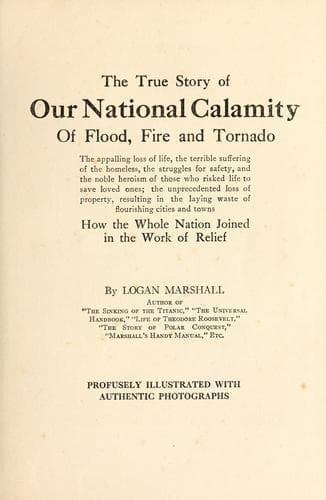
The True Story of Our National Calamity of Flood, Fire and TornadoMarshall, Logan
History
The True Story of Our National Calamity of Flood, Fire and Tornado
Marshall, Logan
Floods -- Ohio River Valley; Omaha (Neb.) -- Tornado, 1913
Hundreds overwhelmed in the rushing floods, hundreds of thousands spared
from sudden death only to suffer hunger and thirst and hardship and the
perils of fire, cities submerged, villages swept away, countless homes
and vast industries destroyed, miles upon miles of populous land drowned
under turbulent waters, and over all the grim shadows of starvation and
disease--this catastrophe defies picture and parallel to express its
desolating horror.
The widespread calamity, which smote with its cruelest force the
beautiful city of Dayton, is one of those for which no personal
responsibility can be placed. Like the tidal flood which devastated
Galveston and the earth upheaval which laid San Francisco in ruins, it
is a convulsion which could not have been foreseen or stayed.
NOT A VISITATION OF PUNISHMENT
In the presence of such a fearful disaster there are few persons who
will say, but there are some who will think, that this is in some manner
a visitation decreed upon the communities which suffer. The very
magnitude and superhuman force of it will suggest to many minds the
thought of an ordered punishment and warning for offenses against a
higher power.
Such a concept, happily more rarely held than in earlier times, is, of
course, revolting to sober judgment and to the instincts of religious
reverence. For it would imply that multitudes of the innocent should
suffer indescribable cruelty; it would attempt the impossible feat of
justifying the smiting of Dayton, where the inhabitants lived lives of
peaceful, helpful industry, and the sparing of communities where men
serve the gods of dishonest wealth and vicious idleness.
This was no vengeance decreed for human shortcomings. It was superhuman,
but not supernatural. It was but a manifestation of the unchangeable,
irresistible forces of nature, governed by physical laws which are
inexorable. Nature knows neither revenge nor pity. She does not select
her victims, nor does she turn aside to save the good who may be in her
path. As her concern is not with individuals, but with the race, so she
is moved not by mercy, but by law.
To the limited vision of man, with his brief life, nature seems
incredibly cruel and wasteful. Her teachings must be learned at fearful
cost. Men will ask themselves what lessons are taught by this
overwhelming sacrifice.
THE HELPLESSNESS OF MAN BEFORE NATURE
There is made plain, first, the utter powerlessness of man when he pits
his strength against the full demonstration of the laws of nature. It is
revealed, again, that there are forces which before all the might of
human intellect remain unconquerable. The same grim lesson confronts the
scientist whose babe is snatched from him by death; it confronts the
millionaire who feels the chill of age creeping upon the frame that has
upheld the finances of a nation and has made and unmade panics with the
crooking of a finger.
THE KINSHIP OF HUMANITY
Public-domain text, read in full here on John Shaqi.
Reviews
Reviews
No reviews yet
Be the first to share your thoughts on this work.
Elsewhere in the archive
Join the Discussion
Join the discussion
Sign in to leave a comment or review.
Sign InorCreate an account