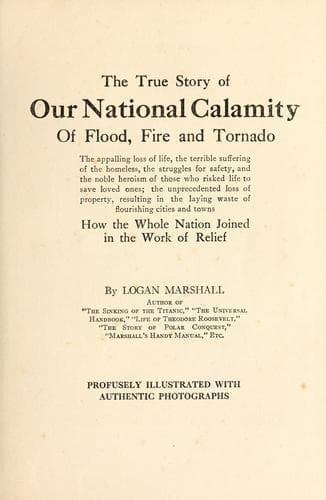
The True Story of Our National Calamity of Flood, Fire and TornadoMarshall, Logan
History
The True Story of Our National Calamity of Flood, Fire and Tornado
Marshall, Logan
Floods -- Ohio River Valley; Omaha (Neb.) -- Tornado, 1913
But the great hidden teaching of disaster is that the laws of nature are
eternal and inexorable; that they move with unerring precision and
resistless force. And this truth applies not only to the tremendous
powers of the hurricane, the flood and the earthquake, but to economic
principles, which are simply a translation into human terms of the laws
manifested in inanimate nature.
The woman whose health is wrecked by overwork, the child whose body and
mind are stunted by early labor, the tenement dweller who falls victim
to disease because of unwholesome conditions of living--these are
sacrifices to natural laws as much as are the thousands swept away in
the floods. But, while the flood deaths are due to an outburst of the
elements which man cannot control, these others are the result of his
defiance of the laws of nature.
There is another difference: The victims of economic wrongs due to
cupidity and indifference outnumber a thousand to one the victims of
natural causes beyond control. All the deaths in these fearful floods
are less than those caused every year in a single large city by
conditions that might be remedied.
Nature decrees that those who do not have certain amounts of fresh air
and food and rest shall die; the law is inexorable. But it is
civilization which defies it and brings down the penalty.
THE AWAKENING TO OTHER LAWS OF NATURE
A stranger thought is that many whose hearts are melted by this disaster
and whose checkbooks open to the suffering survivors are habitually
indifferent to the more deadly conditions existing on all sides of their
homes. Men contribute generously to the relief funds who, if asked to
surrender a fractional part of their dividends in order to make work
safer and more healthful and more humane for employees, would berate the
suggestion as anarchistic.
This is not due to hardness of heart; it is due to faults of vision. Men
display such sympathy in one case and such ruthlessness in another
simply because civilization has not yet advanced far enough to create
generally the sense of responsibility which is called social
consciousness.
There are those who believe that the good impulses aroused by such
events as now appeal to us tend to awaken this consciousness; on the
other hand, a $5,000 contribution to a flood relief fund may, by salving
the conscience of the giver, close his mind to the need for changing
industrial conditions or expending some of his tenement rents for decent
sanitation.
Our own belief is that each calamity brings the minds of the nation into
closer sympathy and hastens the day when all men will understand that
the society they have builded is guilty of causing miseries just as
great as those we are now witnessing, the defying the laws of nature
because of indifference and greed.
THE NEED FOR ACTION
Public-domain text, read in full here on John Shaqi.
Reviews
Reviews
No reviews yet
Be the first to share your thoughts on this work.
Elsewhere in the archive
Join the Discussion
Join the discussion
Sign in to leave a comment or review.
Sign InorCreate an account