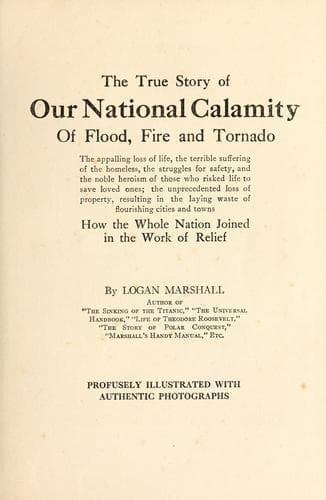
The True Story of Our National Calamity of Flood, Fire and TornadoMarshall, Logan
History
The True Story of Our National Calamity of Flood, Fire and Tornado
Marshall, Logan
Floods -- Ohio River Valley; Omaha (Neb.) -- Tornado, 1913
The Democratic platform contained a plank which promised the support of
the party to a national scheme of river control. This has already been
brought to the attention of President Wilson. With the horrible scenes
of the inundated towns of Ohio and Indiana before them, this pledge is
likely to become a living promise to the party in power.
A PROBLEM FOR THE PANAMA ENGINEERS
There is one thing to remember. Our stupendous enterprise of the Panama
Canal will soon be completed. Its vast equipment of the world's newest
and best machinery for digging and filling will be unemployed. The
world's greatest engineer, Colonel Goethals, will also be at leisure.
Why not then provide for the transfer of all the wonderful machinery at
Panama, under personal charge and direction of Colonel Goethals, to the
supreme necessities of the Mississippi and Ohio valleys? The whole
American people would applaud and approve this disposition of our great
engineer and his great equipment.
This new national necessity is as vital and even more pressing than the
Panama Canal. It is worthy of the great Republic and of the great
engineer--an achievement if successful which would twin with Panama and
make Colonel Goethals immortal and our country's beneficence and
enterprise famous through all time.
We have no force and no leader in this tragic emergency more potent for
the defense of the Mississippi and Ohio valleys than Colonel Goethals
and his Panama machinery. Let us send cheer to the flood-ravaged regions
of our country by the assurance that this great man and this
incomparable equipment will soon be consecrated to their relief.
-----------------------------------------------------------------------
[Transcriber's Note: The following statement was a footnote against the
page number, page 352, on this, the last page. The page number on the
preceeding page was 319, requiring the following edxplanation.]
The 32 pages of illustrations contained in this book are not included
in the paging. Adding these 32 pages to the 320 pages of text makes a
total of 352 pages.
Public-domain text, read in full here on John Shaqi.
Reviews
Reviews
No reviews yet
Be the first to share your thoughts on this work.
Elsewhere in the archive
Join the Discussion
Join the discussion
Sign in to leave a comment or review.
Sign InorCreate an account