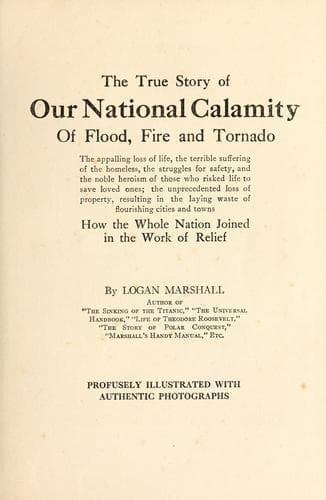
The True Story of Our National Calamity of Flood, Fire and TornadoMarshall, Logan
History
The True Story of Our National Calamity of Flood, Fire and Tornado
Marshall, Logan
Floods -- Ohio River Valley; Omaha (Neb.) -- Tornado, 1913
By order of Governor Cox, the reign of martial law over Dayton was
extended to take in the whole county. The flood did more than sweep away
property, for it swept away the city administration, temporarily at
least, and brought in what amounted to a commission form of government.
The extension of the area under martial law developed from action taken
by local dealers whose places were closed. They complained that saloons
on the outskirts were sending whiskey into the city, and that
considerable drunkenness had been observed. Brigadier-General Wood
reported the situation to the Governor, and his action was prompt and
decisive.
COMMISSION GOVERNMENT ESTABLISHED
As soon as martial law was proclaimed, the municipal administration was
eclipsed. Brigadier-General Wood for the moment became supreme under the
Governor. On the heels of this Mr. Patterson was appointed chairman of a
committee of five to administer the affairs of the city. The militia was
instructed to obey his orders and thus became a police force.
Under martial law the city enjoyed the free services of the biggest
business men and the most expert professional men in Montgomery County.
Citizens who ventured into the streets were impressed from the time they
left their doors that Dayton is steadied and perhaps somewhat depressed
by the absolute grip of martial law. Soldier government was maintained
inexorably. Owners of business places could not set foot on their
property without the permission of the khaki-clad militiamen, standing
at the curbs with loaded carbines. If a citizen found himself some
distance from his home when the curfew rang at 6 P. M. his return was
beset with much difficulty, because of the necessity of halting by the
many sentries he encountered.
A citizen fearsome enough to venture from his threshold after 8 P. M.
literally took his life in his hands, because the fingers of the militia
rested on hair triggers.
Nine colored men and one white man were added to the seven suspected
looters shot and killed since martial law was proclaimed. Absolute
secrecy concerning the deaths was maintained by the military
authorities. Citizens who heard repeated firing between midnight and
dawn in the business center of Dayton and near Ludlow Street, in which
were located many of the handsomest homes in Dayton, spread these
reports. The reports were confirmed in a non-committal way by militiamen
who were on duty in these sections, who admitted they had fired ball
cartridges as a "warning" to suspected looters.
Public-domain text, read in full here on John Shaqi.
Reviews
Reviews
No reviews yet
Be the first to share your thoughts on this work.
Join the Discussion
Join the discussion
Sign in to leave a comment or review.
Sign InorCreate an account