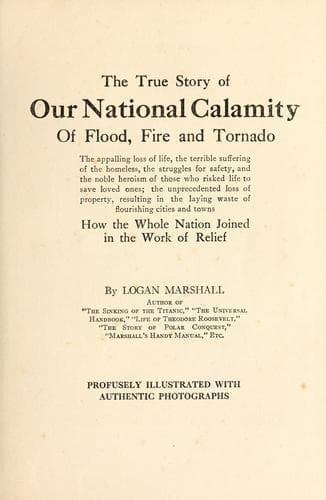
The True Story of Our National Calamity of Flood, Fire and TornadoMarshall, Logan
History
The True Story of Our National Calamity of Flood, Fire and Tornado
Marshall, Logan
Floods -- Ohio River Valley; Omaha (Neb.) -- Tornado, 1913
The most detailed account of the death of the white man had it that he
was halted near Main and Third Streets shortly after 2 A. M. He had one
hand behind his back, and when ordered to open it two watches fell to
the pavement. He was then searched and eighteen watches were found in
his pockets. The sentry called a corporal's squad of six militiamen and
reported the loot found on the prisoner. The prisoner was led to the
wall of a near-by building, faced toward the wall, and the squad, which
had received instruction from its commander, fired. A white band with a
red insignia, made apparently to simulate a Red Cross badge, was taken
from the man's arm, and the body was thrown into the canal.
EXECUTIONS DENIED
The nine colored men reported as killed were discovered by sentries in
various parts of the city. A dozen militiamen on duty near Main and
Third Streets, about 2 A. M., said that they had heard firing at the
locality named, but attributed it to warning shots. One of the men said
that a sergeant in his company told of shooting and killing a colored
man Friday night, when the man tried to escape in a boat on the Miami
Erie Canal.
Brigadier General George H. Wood, when asked about the reports of
squad-firing and the deaths of ten suspected looters, said:
"There was some squad-firing after midnight by sentries posted in the
Ludlow section, where are located the homes of some of Dayton's
wealthiest citizens. But neither there nor in other sections of the city
where shots were fired was any one killed. The report that executions
followed the detection of militiamen caught looting are without
foundation. There have been no drumhead or other courtmartials and none
will take place while I am in command here in Dayton.
"We have the situation well in hand. I have 1,400 doing sentry duty
throughout the city and I intend to guard homes and suppress all
lawlessness."
In spite of the rigor of this military government of Dayton, praise of
General Wood's administration was heard on every side. Citizens
discredited the stories of executions of looters and were not
over-inquisitive of details, because they realized that drastic measures
were imperative under the existing conditions.
In accordance with suggestions made Saturday by Secretary of War
Garrison and General Leonard Wood, chief of staff, Major Thomas L.
Rhoades, President Wilson's military aide, took charge of the sanitary
campaign and permanent relief organization. He had for his chief
lieutenant Eugene T. Lies, of Chicago, who was in command of the Red
Cross forces. Investigation of the financial standing of every
householder whose home has been damaged by the flood was begun. In
worthy cases money or materials with which to make repairs were
furnished from the Red Cross funds.
A HOME OF TENTS
Public-domain text, read in full here on John Shaqi.
Reviews
Reviews
No reviews yet
Be the first to share your thoughts on this work.
Join the Discussion
Join the discussion
Sign in to leave a comment or review.
Sign InorCreate an account