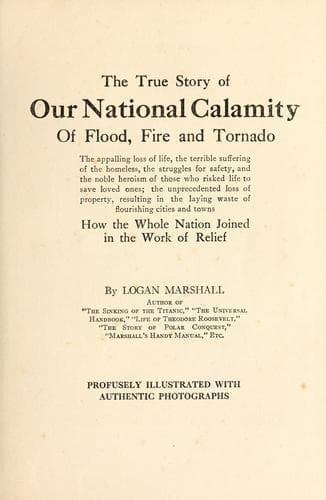
The True Story of Our National Calamity of Flood, Fire and TornadoMarshall, Logan
History
The True Story of Our National Calamity of Flood, Fire and Tornado
Marshall, Logan
Floods -- Ohio River Valley; Omaha (Neb.) -- Tornado, 1913
The postoffice was put out of business on Tuesday and it was not until
Sunday that any sort of service was attempted. Telegraph and telephone
service was almost entirely crippled until Saturday night, when even
short messages were accepted only on condition that the sender assent to
indefinite delays.
Telegrams were relayed through Cincinnati. The only long-distance
telephone wires in service were two private wires connecting with
Cincinnati. On those who succeeded in securing permission to use these
wires a time limit of three minutes conversation was imposed.
No braver services were performed during the flood than those by the
telegraph and telephone linemen who made possible the dissemination of
news to hundreds of thousands of friends and relatives of Daytonians.
They waded and swam icy floods and entered tottering buildings
unhesitatingly in pursuit of their duty. Operators who had not removed
shoes or clothing since last Tuesday were found Saturday.
RAILROADS AGAIN WORKING
Direct railroad communication was established Sunday night with
Springfield, Ohio, Cincinnati and Richmond, Indiana. The Cincinnati,
Hamilton and Dayton lines, on which Dayton passenger traffic depended
mostly, were not working. The tracks leading into the Union Station were
completely blocked and the few trains arriving discharged their
passengers on the outskirts of the city.
H. E. Talbott, who was commissioned by Governor Cox, chief engineer of
the military zone, completed his plans for beginning the rehabilitation
of the city. He announced that four departments had been created, with
an assistant engineer in charge of each. One had charge of rebuilding
the streets and alleys; another the levees along the rivers; another the
sewerage system, and still another the bridges.
[Illustration: Photograph by Underwood & Underwood, N. Y.
Life lines strung across one of the streets. The rescuers caught persons
carried down on wreckage in the raging flood and brought them to a place
of safety]
[Illustration: Copyright by Underwood & Underwood, N. Y.
Man walking along the telephone cables after escaping from his house,
which was washed away by the flood. The houses in the center have been
washed from their foundations and are floating away]
Hundreds of persons still looking for relatives passed along the lines
at the morgues, fearing they should find their loved ones there. Only a
few bodies had not been identified.
Because of the city's financial condition, the problem of paying the
costs of rejuvenation caused great concern. The treasury was practically
empty, and the borrowing capacity would be exhausted when $900,000 was
raised. It was planned to seek immediate relief from the Legislature.
Public-domain text, read in full here on John Shaqi.
Reviews
Reviews
No reviews yet
Be the first to share your thoughts on this work.
Join the Discussion
Join the discussion
Sign in to leave a comment or review.
Sign InorCreate an account