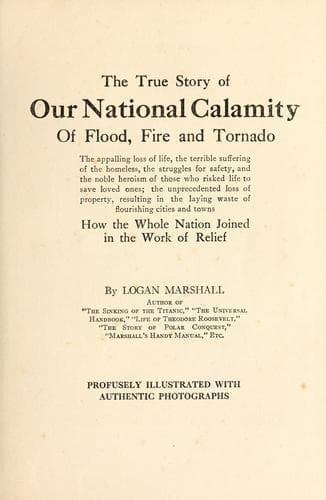
The True Story of Our National Calamity of Flood, Fire and TornadoMarshall, Logan
History
The True Story of Our National Calamity of Flood, Fire and Tornado
Marshall, Logan
Floods -- Ohio River Valley; Omaha (Neb.) -- Tornado, 1913
Major Rhoades took up plans for establishing a tented camp in North
Dayton in which to shelter residents of the flood districts. These
flooded homes were inspected and when found to be unsanitary the
occupants were invited to take up quarters in the tented camp. Where the
invitation was refused recalcitrants were escorted by a corporal's guard
to the camp and compelled to remain there until their homes were cleaned
and fumigated. Major Rhoades was supported by the militia in carrying
out a policy to immunize every home in Dayton if necessary, and thus
minimize the danger of epidemics.
The medical authorities forbade the use of old clothing until after it
had been fumigated. It was urged upon the general public that old
clothing was not desirable for fear it might bring a pestilence in some
form to a city unable to cope with more disaster.
Nothing to indicate the approach of an epidemic due to flood conditions
was reported, although the number of diphtheria cases was slightly above
normal. Eight persons suffering from diphtheria were at the Miami Valley
Hospital. Seven of them were caught in a house with a person who had
recently become ill with the disease. Four persons hemmed in with one
who had measles were suffering with that disease. Typhoid fever and
pneumonia were a little more prevalent than usual. Clear skies and warm
sunshine contributed to the comfort of the city and made possible good
progress in the work of redemption.
Two hospitals in Dayton were flooded on the first floor, so all sick and
injured were taken either to the Great Miami Hospital or to the state
insane asylum. Eight persons whose minds temporarily became affected
because of hardships suffered in the flood were cared for at the latter
place.
With warmer weather, the greatest problem was the removal of the
carcasses of dead horses. Every available automobile truck and all the
horse-drawn drays were impressed by the sanitary officials and hundreds
of men were engaged all day removing the carcasses to the different
incinerating plants and to vacant lots on the outskirts of the city,
where they were burned.
George F. Burba, Governor Cox's private secretary, reported to the
state's executive that there were 40,000 persons in Dayton who must be
fed and sheltered for at least a week, and 10,000 who were destitute.
The latter were without either sufficient clothing or food, and until
business activities were restored, they had to be financed and
maintained in lodgings until they could become self-supporting.
Theodore A. Burnett and T. H. Smith, government food inspectors, took
charge of the food supply, in so far as inspection was concerned, and
appointed twelve deputies. All shipments of supplies from other places
were carefully examined before being given to the refugees. Particular
attention was paid to meats and canned goods.
Public-domain text, read in full here on John Shaqi.
Reviews
Reviews
No reviews yet
Be the first to share your thoughts on this work.
Join the Discussion
Join the discussion
Sign in to leave a comment or review.
Sign InorCreate an account