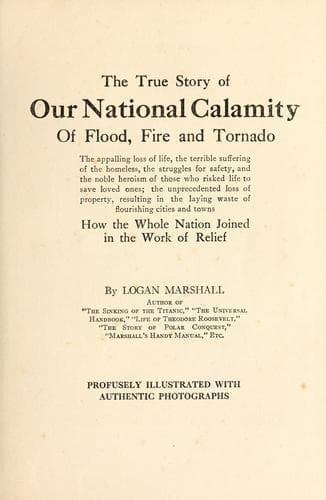
The True Story of Our National Calamity of Flood, Fire and TornadoMarshall, Logan
History
The True Story of Our National Calamity of Flood, Fire and Tornado
Marshall, Logan
Floods -- Ohio River Valley; Omaha (Neb.) -- Tornado, 1913
Announcement was made that the particular need of the people was
drinking water, shoes, clothing, picks and shovels. Money also was
wanted, although a considerable amount had already been subscribed by
cities throughout the country.
Food was on hand in ample quantities, free to all, but the variety was
limited to staples such as beans, potatoes, bread and canned vegetables.
Of fresh meat there was practically none and butter and eggs were
scarce. All food supplies were those contributed by the outside world
and distributed from the various relief depots on the requisition of
householders. Neither provision nor other stores received any
consignment of goods.
Citizens and visitors alike were impressed with the facts that Dayton's
condition was distressing. A review of the streets from sunrise until
the curfew bell's toll furnished a practical illustration of this.
Except for the comparatively few householders who had supplies on hand
in considerable quantities, daily sustenance was secured by the market
basket method. This was as true of the fairly well-to-do families as of
the laboring classes.
HOW RATIONS WERE ISSUED
The head of a family made out a requisition each morning stating his
needs for the day. This requisition was presented at any of the supply
depots, and on it were issued rations consisting of potatoes, canned
meats, prunes or preserves, beans, biscuits or bread. Men, women and
children with their baskets were seen in the streets throughout the day.
Most of the absolutely destitute were cared for in one or another of the
buildings comprising the huge plant of the National Cash Register
Company, which is on high ground at the southern end of the city,
untouched by the flood. On the ninth floor of the administration
building, known as the office's club, and where there is a dining room
with a capacity for 1,000, more than 5,000 destitute persons were fed
daily. The menu for Sunday was a typical one, as follows:
Breakfast--Oatmeal and milk, coffee and bread.
Dinner--Vegetable soup, stewed canned meat, stewed corn, coffee and
bread.
Supper--Bean soup, potatoes, coffee or tea and bread with butter.
John F. Patterson, head of the plant, had his dinner in this general
dining room on Sunday. The only luxuries enjoyed by him and not provided
for the others were hard-boiled eggs and preserved peaches. Among the
most active of the uniformed waitresses was Mr. Patterson's
nineteen-year-old daughter. Volunteer waitresses helped out their paid
sisters during these days of hardship.
Monday in Dayton was much like the days that immediately preceded it,
except that rapid progress was made toward the restoration of the city
to a habitable condition. Electric current was supplied Monday night in
a limited residential district and in a few downtown buildings, and the
narrow zone of street lighting was extended. Automobile fire engines
were brought overland from Cincinnati to assist in pumping out
basements.
Public-domain text, read in full here on John Shaqi.
Reviews
Reviews
No reviews yet
Be the first to share your thoughts on this work.
Join the Discussion
Join the discussion
Sign in to leave a comment or review.
Sign InorCreate an account