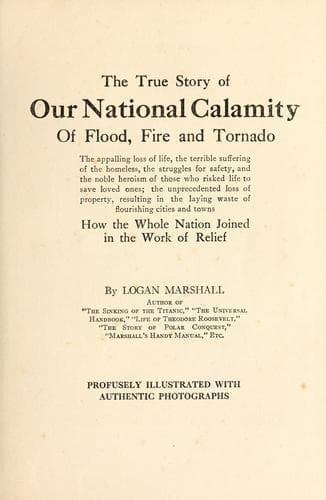
The True Story of Our National Calamity of Flood, Fire and TornadoMarshall, Logan
History
The True Story of Our National Calamity of Flood, Fire and Tornado
Marshall, Logan
Floods -- Ohio River Valley; Omaha (Neb.) -- Tornado, 1913
So day followed day in the recuperation of Dayton; but, looking ahead,
it was evident to the magnificent corps of expert men in charge of the
work that months must elapse before all Daytonians could again live in
their own homes. There were 15,000 residences to plaster and paper
before they could be occupied. There were 4,500 houses to build
foundations under, to straighten, re-roof, put in doors and windows,
rebuild chimneys and make other repairs before their owners could move
in again. There were 2,000 houses to raze and new structures to be
built.
The Citizens' Relief Committee, on advices from engineers, decided that
this reconstruction work would require four months, even if building
material could be obtained promptly.
So far as the business and industrial buildings were concerned, it was
estimated by architects who looked over the different premises that it
would require eight months before repair work and rebuilding could be
accomplished. In the interim business was done in whatever premises were
available.
Thousands of men were employed, together with many teams of horses, and
work was pushed to the utmost in all departments. Surveys of the damage
done were made and large quantities of material were ordered by
telegraph, to be shipped immediately.
Generations must come and go before the Dayton flood will be forgotten,
and standing out in bright contrast with all else there will perhaps
remain longest the inspiring picture of the energy and fortitude with
which the stricken residents set about the retrievement of their city
from the devastation of the angry waters.
CHAPTER VI
DAYTON: "THE CITY OF A THOUSAND FACTORIES"
SURVIVOR OF SIX FLOODS--ESTABLISHED BY REVOLUTIONARY
SOLDIERS--PHYSICAL CHARACTERISTICS--OTHER OF DAYTON'S FEATURES OF
INTEREST--A CITY OF CIVIC PRIDE--"A THOUSAND FACTORIES"--ITS
SUCCESS.
Dayton has stood in the shadow of disaster from flood ever since its
foundation. No less than six times previous to the present inundation
have the rivers which flow through it left their accustomed courses and
brought death and destruction of property upon the town. The first of
these floods occurred in 1805, the very year that Dayton was
incorporated as a town. The sixth was in 1898 and the others in the
years 1847, 1863, 1866 and 1886.
The site of the present city was purchased in 1795 by a group of
Revolutionary soldiers and laid out as a town in the following year by
one of them, who named it after Jonathan Dayton, a Jerseyman who had
fought in the Revolution and who later served in Congress and the United
States Senate. It became the county seat of Montgomery County in 1803
and received its city charter in 1841, something more than a score of
years after the opening of the Miami Canal gave a boom to its growth and
prosperity.
Public-domain text, read in full here on John Shaqi.
Reviews
Reviews
No reviews yet
Be the first to share your thoughts on this work.
Elsewhere in the archive
Join the Discussion
Join the discussion
Sign in to leave a comment or review.
Sign InorCreate an account