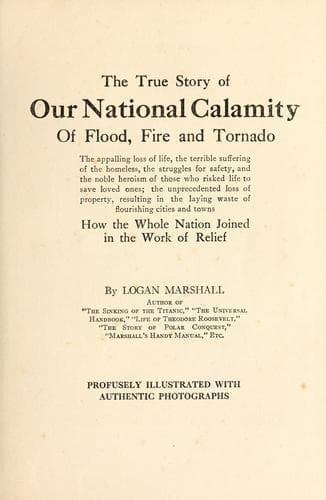
The True Story of Our National Calamity of Flood, Fire and TornadoMarshall, Logan
History
The True Story of Our National Calamity of Flood, Fire and Tornado
Marshall, Logan
Floods -- Ohio River Valley; Omaha (Neb.) -- Tornado, 1913
At Columbus, on Tuesday night, March 25th, darkness settled down on a
swirling flood that covered large areas of the city. Thousands of
persons were separated from members of their families and were frantic
because they were unable to get into communication with their homes.
THE RISING FLOOD
Hundreds of fathers, sons, brothers, sisters and daughters had left
their homes on the west side of the city in the morning to go to work,
before the Scioto River had reached a flood stage. Rising suddenly, the
water cut them off from their homes and when night fell they only knew
that their homes were flooded and that the members of their families
were dependent for food and shelter on more fortunate neighbors.
Because the city was in darkness, only meager details of the condition
of the flood-marooned inhabitants were obtainable.
Wringing their hands, weeping and appealing vainly for help, scores of
girls crowded in as close to the water's edge in the darkness as state
troops and policemen on duty would allow them, but there was no chance
to cross the stream to their home district.
MOST OF THE CITY DARK
Owing to the high water, electric lights in the flooded district and a
part of the business section of the city were out, and the water supply
was cut off. The supply of gas was also cut off, with a view to
preventing explosions.
In Columbus the west side was practically wiped out, and the reported
loss of life ranged from a half dozen to 200. Houses were floating down
the river with people on their roofs. Several fires in the submerged
district added to the horrors. Refugees slept in public buildings, while
militia helped the police patrol the streets, which were in total
darkness.
It was estimated that over 10,000 persons were homeless on the west side
as a result of the flood and that at least 15,000 were living on the
second floors of their homes. Only about ten per cent of the street cars
were able to operate and steam railroad and suburban lines were tied up.
Damage amounting to $30,000 was done by fires in the west side during
the afternoon, which for a time threatened greater damage owing to the
water supply being cut off. Even had there been water, most of the
fire-fighting facilities were on the east side of the city and unable to
reach the section affected.
GREAT AREA UNDER WATER
Bridges connecting the west side with the eastern portion of Columbus
were swept away shortly after noon. Dozens of smaller bridges went down.
Hundreds of men were marooned in factories on the west side, and police
and National Guardsmen were making rescues in boats where it was
possible. All street car traffic was abandoned. Fifteen hundred homes
were flooded.
Public-domain text, read in full here on John Shaqi.
Reviews
Reviews
No reviews yet
Be the first to share your thoughts on this work.
Elsewhere in the archive
Join the Discussion
Join the discussion
Sign in to leave a comment or review.
Sign InorCreate an account