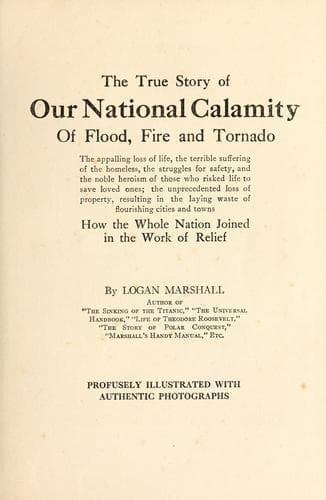
The True Story of Our National Calamity of Flood, Fire and TornadoMarshall, Logan
History
The True Story of Our National Calamity of Flood, Fire and Tornado
Marshall, Logan
Floods -- Ohio River Valley; Omaha (Neb.) -- Tornado, 1913
Governor Cox also sent out appeals for aid to the Governors of all the
border States of Ohio, including Pennsylvania, West Virginia, Michigan,
Indiana and Kentucky. Tents and provisions were badly needed, according
to the Governor's appeal.
After working all night in the Adjutant-General's office in the State
House, officers of the Ohio National Guard reported that they had
succeeded in assembling 3,500 militiamen, ready for service in the flood
districts.
Mobilized at all points of the state, companies and regiments of the
Ohio military force started at daybreak on Wednesday for the stricken
cities and towns as soon as arrangements for their transportation, the
most serious problem confronting the militia headquarters, could be
arranged. The relief which they carried was held back by the lack of
railroad facilities everywhere.
THE RELIEF OF THE VICTIMS
Howard Elting, president of the Chicago Association of Commerce,
telegraphed Governor Cox that citizens of Chicago were raising a relief
fund for flood sufferers.
"I am pleased to state," the telegram said, "that $100,000 will be
placed at the disposal of Ohio through the American Red Cross Society."
The Senate passed the Lowry Bill making appropriation for the relief of
the flood sufferers, but increased the amount to $500,000.
The action was taken in response to the following message from the
Governor:
"The flood disaster that has befallen our state is of such magnitude in
loss of life and human suffering that I respectfully urge upon your
honorable body the importance and propriety of making an appropriation
for the succor of those in distress.
"May I further suggest that it be of such size and made with such
dispatch as to reflect the great heart and resource of our
commonwealth?"
THE EXTENT OF THE DISASTER
On Thursday it was apparent that the part of the city between Central
and Sandusky Avenues was almost wiped out, and estimates of the death
toll of the flood in this city ran into the hundreds.
It was not until Thursday when the waters began to recede, and after two
nights of horror, during which hundreds of people clung to the
housetops, while others sought safety in trees, that the fact dawned
upon the inhabitants that their city had been visited by as great a
calamity perhaps as that which had fallen upon the Miami Valley.
The bodies of 200 persons lay huddled in the United Brethren Church on
Avondale Avenue, according to O. H. Ossman, an undertaker, who explored
the flood district in a rowboat.
He said this report was made to him by a man who said he had been able
to reach the building and look through the windows. Police who sought to
confirm the story were unable to reach the church because of the
current.
Ossman said nineteen bodies had been taken to his undertaking rooms and
that he has been asked to be prepared to care for sixty-nine other
bodies. He said he counted fully two hundred bodies in wreckage on West
Park Avenue.
Public-domain text, read in full here on John Shaqi.
Reviews
Reviews
No reviews yet
Be the first to share your thoughts on this work.
Elsewhere in the archive
Join the Discussion
Join the discussion
Sign in to leave a comment or review.
Sign InorCreate an account