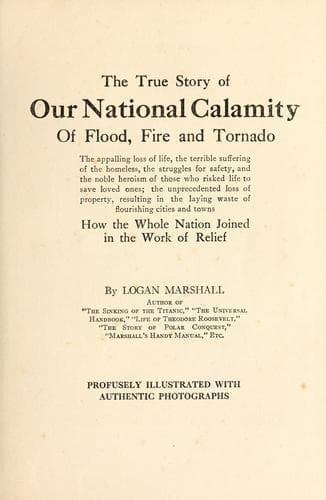
The True Story of Our National Calamity of Flood, Fire and TornadoMarshall, Logan
History
The True Story of Our National Calamity of Flood, Fire and Tornado
Marshall, Logan
Floods -- Ohio River Valley; Omaha (Neb.) -- Tornado, 1913
Members of searching parties who were able to explore the west side of
the city, south of Broad Street, for the first time reported that that
section was a scene of vast desolation for a great area, much of it
being still under water.
The names of more than a half hundred persons were placed under the
caption "known dead," while the list of probable dead was too great to
be collated at that time. The number of missing and unaccounted for, it
was said, would reach far into the hundreds.
An Associated Press operator, who was marooned for hours in the flood
after it broke early Tuesday, reached the Columbus office Thursday after
having traveled by a circuitous route covering more than forty-five
miles in order to get into the main portion of the city.
He saw more than a score of bodies washed through the flood, and said
that house after house was carried away in the flood. Many of the small
frame cottages were wrenched to pieces by the currents and their
occupants thrown into the water to be seen no more.
It was believed that many bodies would be found at the Sandusky Street
bridge or lodged against such part of it as was left in the river at
that point. Further exploration of that part of the west side was begun
Thursday afternoon.
Because she had no home after she was rescued from the flood district,
Miss Florence P. Shaner and William G. Wahlenmaier were married. They
had intended being married in May. The girl was rescued by Wahlenmaier.
Her mother was drowned and their home swept away.
STORIES OF THE HORROR
Other men who had ventured into the flood district told corresponding
stories of awful loss of life. To add to the horrors of the situation
reports reached the State House that the buildings in the flood-swept
district were being looted by men in rowboats. To meet this emergency
and to better patrol the west side, which is under martial law, Governor
Cox ordered Troop B of the National Guard to patrol the ruined section
of the city. It was believed the cavalrymen could cover more territory
than foot soldiers.
As the waters receded the militia guarded the west side under
arrangements made between the Adjutant-General's department and Chairman
Nass of the Columbus Relief Committee.
Hundreds of people were still marooned in flooded homes, their rescue up
to that time being impossible because of the swift current of the
river. Rescued people in dire straits were brought to the City Hall in a
stream all day, where people by the hundreds waited to obtain news of
missing relatives and friends.
Families were separated, and men, women and children stood night and day
at the edge of the water waiting for the flood to subside that they
might reach abandoned homes.
The body of a man was suspended in a tree near Glenwood Avenue, beyond
reach of the rescuing parties. Other bodies were among debris washed up
on the edge of the waters in the southwest end of the city. Near this
debris were two submerged street cars.
Public-domain text, read in full here on John Shaqi.
Reviews
Reviews
No reviews yet
Be the first to share your thoughts on this work.
Elsewhere in the archive
Join the Discussion
Join the discussion
Sign in to leave a comment or review.
Sign InorCreate an account