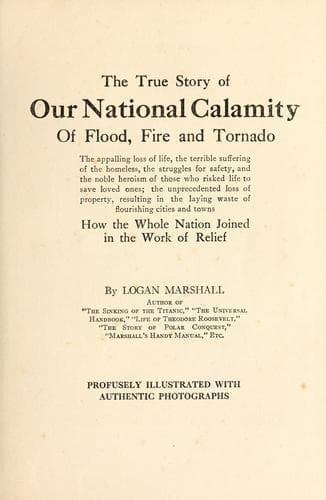
The True Story of Our National Calamity of Flood, Fire and TornadoMarshall, Logan
History
The True Story of Our National Calamity of Flood, Fire and Tornado
Marshall, Logan
Floods -- Ohio River Valley; Omaha (Neb.) -- Tornado, 1913
"It is impossible to tell how many lives were lost at Peru," said one of
the rescuers.
Six survivors were suffocated in the overcrowded court house. The
weather had turned severely cold, adding to the misery of the
unsheltered, but the flood was falling rapidly.
Terrible conditions prevailed among the refugees, who were increasing in
numbers, as the waters receded. Sanitary conditions among the hundreds
sheltered in the court house became so bad that boats removed many of
them to other places.
GREED ABROAD IN THE CITY
The water was rushing back as fast as it came, leaving a coat of mud and
slime. It was from this that the great danger of disease existed. The
state board of health combined with the Peru board to help clean up.
Relief workers and city officials joined to investigate statements
concerning exorbitant prices for foodstuffs, and proposed to expose
every merchant attempting to make money through the misfortunes of
others.
Several looters were arrested and others shot. One robber was shot by a
citizen, who threw the body into the river.
The work of rescue was greatly impeded by the selfishness of residents.
An Indian of the Wallace circus secured a boat and charged people $200
before he would help them off. Instances were told of men who drew
revolvers on the men and boys working in the boats, threatening to shoot
if they did not take them in.
REFUGEES URGED TO LEAVE
Railroad officials and the relief committee urged refugees to accept the
hospitality of the municipalities north. They hoped to be relieved of
temporary care of 3,000 persons by sending them out of the city.
Two railroads were bringing plenty of provisions within a half mile of
the city, but the boats could not transport rapidly enough to the center
where the supplies were being distributed.
SEARCH FOR THE DEAD
Systematic search for the dead was made, and the appalling early reports
of hundreds of dead continued to shrink, although it was believed that
the search would probably reveal more. The diminution was due to the
discovery in the hills on the other side of the Wabash River of hundreds
of persons who had been given up as dead.
The streets were strewn with dead animals that had begun to decay in
some sections. An epidemic was feared. One of the greatest obstacles
which the people faced was that of ridding the city of the dead animals
and filth in the low sections around the edge of the city proper into
which disease-breeding filth had been washed.
Water still covered these low sections, and seemed likely to remain
there for a long time. There were few sections around the valley that
could be used for burning dead animals.
Citizens and officials who were becoming alarmed at the new danger
estimated that at least 500 dead animals were strewn about the city of
Peru alone. Most of them had to be fished out of the water wherever
found, and it seemed an impossible task.
SHAKING OFF DESPAIR
Public-domain text, read in full here on John Shaqi.
Reviews
Reviews
No reviews yet
Be the first to share your thoughts on this work.
Elsewhere in the archive
Join the Discussion
Join the discussion
Sign in to leave a comment or review.
Sign InorCreate an account