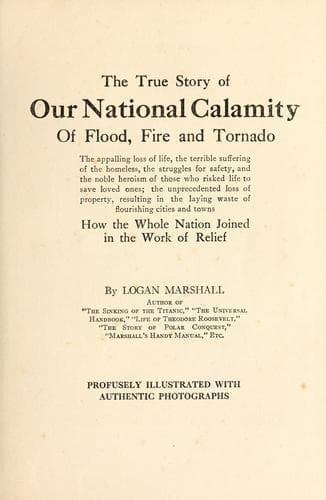
The True Story of Our National Calamity of Flood, Fire and TornadoMarshall, Logan
History
The True Story of Our National Calamity of Flood, Fire and Tornado
Marshall, Logan
Floods -- Ohio River Valley; Omaha (Neb.) -- Tornado, 1913
Rescue work started as soon as the people were able to hurry to the
stricken district, but the night's work was by the light of lanterns and
little was accomplished. The storm took down all the wires in its path
and the electric power was shut off immediately to prevent further loss
of life. All night the stricken section was patrolled by government
troops from Fort Omaha.
With the arrival of daylight, a train-load of militia from Lincoln and
the presence in the city of Governor Morehead, the work was
systematized.
[Illustration: MAP SHOWING THE PATH OF THE TORNADO]
The hospitals in Omaha Sunday night were full of injured, many of whom
had not been identified, apparently because their friends were either
dead or among the injured.
A CITY TO THE RESCUE
Immediately City Commissioners appropriated $25,000 for relief work;
citizens present at the meeting organized and donated $25,000 more. The
Citizens' Relief Committee was organized, composed of fifty citizens and
an executive committee of seven to work with the seven city councilmen.
Governor Morehead notified Mayor Dahlman that he would send a special
message to the Legislature asking for the appropriation of sufficient
funds to care for the homeless throughout the state.
Cots were placed in the Auditorium, and those without shelter were
housed here. The city purchasing agent arranged for enough beds to care
for all those who could sleep in the Auditorium. The Elks' rooms were
thrown open to the homeless and the Union Gospel Mission provided
seventy-five men with beds.
PATH OF THE STORM
The storm appeared to have started at Fifty-fourth and Center Streets.
From there it traveled north, veering slightly to the east, to
Leavenworth Street. Then it took a northeasterly course to Fortieth and
Farnam Streets, sweeping its way through everything. Still traveling a
little east of north, it covered a course from Fortieth Street east to
Thirty-fourth Street, six blocks.
Striking Bemis Park, where the homes of the wealthy Omaha residents were
located, the storm turned sharply to the east and passed along Parker
and Blonde Streets, to Twenty-fourth Street, where its path was six
blocks wide. In the latter section the damage was complete.
Finally, at Fourteenth and Spencer Streets, the storm swept over the
bluffs, high above the Missouri River, demolished the Missouri Pacific
roundhouse, leveled the big trestle of the Illinois Central Railroad
over Carter Lake, wrecked several buildings near the Rod and Gun Club, a
fashionable outing place, and disappeared to the northeast.
The Child Saving Institute was a veritable death house after the storm
had spent its fury. Every available room was pressed into service, and
one after another the dead and injured were brought into the house.
INTERRUPTED MERRYMAKERS
Public-domain text, read in full here on John Shaqi.
Reviews
Reviews
No reviews yet
Be the first to share your thoughts on this work.
Elsewhere in the archive
Join the Discussion
Join the discussion
Sign in to leave a comment or review.
Sign InorCreate an account