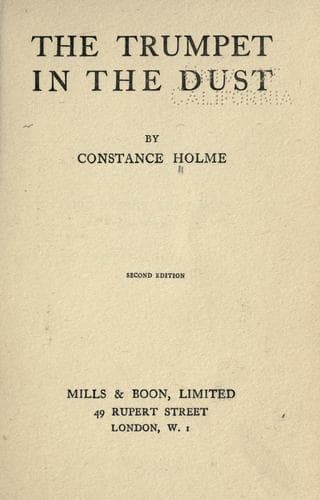
Almshouses -- Fiction; Older women -- Fiction; Villages -- England -- Fiction; Women cleaning personnel -- Fiction
It is always the child for whom a mother weeps when a son or a
daughter dies; not the strong man or the mature woman, but the child
whom she sees through and behind them and in them all their lives.
The adult may have her confidence and pride, but it is the still
faintly discerned child that holds and keeps her love. She looks up
to the former, and is even a little afraid; the latter looks up to
her, and sees her as God. For a mother, indeed, a child dies as soon
as it ceases to be a child, though she may not weep for it then.
Life, passing on inexorably, tells her that it is against nature to
weep for this purely natural change. It is only when the grown man or
woman, whom perhaps she can hardly recognise, is laid to rest, that
she is allowed to weep. Then at last she may cry her heart out for
the child who died but was never buried ever so long ago.
So it was for the child Tibbie that Mrs. Clapham wept, seated in
the rocking-chair with the angry voice, her head dropped on the
table on her outflung arms, and beside her the little lame chair
resting lob-sidedly on the hearth. It was worm-eaten, it had lost
a leg—the cane seat was ripped across; but it was still alive, as
all much-used pieces of furniture are alive until they finally come
to the axe. And indeed the personality of this chair was such as it
seemed even the axe could hardly destroy. Low-legged, broad-seated,
with a curved mahogany back, it had been a present to Tibbie from an
old Colonel who lived in the place. A martyr to rheumatism himself,
it had troubled him sorely to see the child sitting so often on the
cottage step. “Suffer for it—she’ll suffer for it!” he used to say,
stopping stiffly in front of her as he hobbled past; and after he had
said it a time or two, he had sent the chair. Tibbie had simply lived
in it from that time on—played in it, eaten, chattered and fallen
asleep. It had had its place by the window in summer, by the fender
during the winter. It was the centre of great games played by Tibbie
and others out in the street, and she had even been seen, bound on
some errand, dragging it after her on a string. It was a wonder,
indeed, that it did not attend her to school. When she was older
again she had sat in it while she sewed, the centre of billows of
drapery sweeping all over the floor. The last time she had sat in it
was with Baby Steve in her arms, her laughing fair head leaned to his
sad eyes.... But it was neither as the young dressmaker nor as the
young mother that Mrs. Clapham could think of Tibbie just then. The
years of maturity were all of them wiped out, leaving only the many
pictures of the child and the little chair.
Public-domain text, read in full here on John Shaqi.
Reviews
Reviews
No reviews yet
Be the first to share your thoughts on this work.
Elsewhere in the archive
Join the Discussion
Join the discussion
Sign in to leave a comment or review.
Sign InorCreate an account