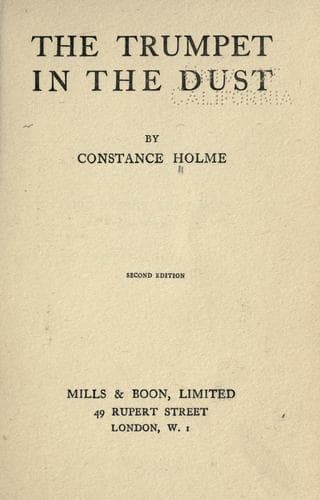
Almshouses -- Fiction; Older women -- Fiction; Villages -- England -- Fiction; Women cleaning personnel -- Fiction
“Eh, but it’s a shame, though, that it is—and you wi’ your lame leg
an’ all! Not so young as you was, neither.” She was careful, however,
not to lay too much stress upon age. “You’ve a right to your rest.”
“I can work till I drop....”
There was a pause, and then Emma changed her tactics again, or,
rather, intensified them. Coming slightly nearer, she inclined her
stiff little figure—the nearest approach that she had ever been known
to make to an actual bend.
“Hark ye, Ann Clapham!” she began rather breathlessly, and in a voice
that actually shook. “Let’s talk this matter over reasonable-like;
let’s thrash it out, you and me. I don’t mind telling you right off
the reel as I’m right set on having them barns. You mustn’t take it
amiss if I mention for once as they’re my grandchildren as well as
yours. When all’s said and done, they’re the barns o’ my poor lad
as went down in t’ War. They’re that like him an’ all; it’s only
in nature I should want to have ’em. Likely they don’t think much
of me, as you say, but I could soon learn ’em. Children often take
queer-like fancies agen the people as likes ’em best.”
Again Mrs. Clapham’s face came slowly round towards the one that was
almost bending over her. “What was it you did to Poor Stephen?” she
inquired dully.
Emma reddened in spite of herself, a dark-red flush very different
from the glow of excitement with which she had come in. As Mrs.
Clapham looked, something seemed to rise up in her that would no
longer be repressed, something that rose and rose as if determined
to break into speech, but was finally beaten at the door of her open
mouth. You saw it yield, as it were, sink, die down, fall and fade
away, thrust back on its chain into the place from which it had
come....
“Nay, now, you’re never going to rake that up again, surely!” she
demanded, though quite gently. “I never see such a clattin’ spot as
this here village! They’ll never let owt die. I did think they’d
put a string to their tongues when Stephen went down in t’ War, but
seemingly I was wrong. Of course I’ve known all along as they thought
I didn’t do right by my poor lad. A ter’ble grief it’s been to me an’
all, though I never let on. I shouldn’t be speaking of it now if it
was to anybody but you!”
She gave a deep sigh, crossed her arms and uncrossed them again, and
it seemed to Mrs. Clapham that her lips actually trembled.
“That’s all very well, Emma Catterall,” she replied presently, in the
same dull tone of condemnation, “but there’s no getting past the fact
you were right bad to Poor Stephen. You know best what you did to the
poor lad; I won’t say how I know it, too. But all the lot on us who
was living here then know he was half-clemmed and nearly daft.”
“Stephen told you I was bad to him, I reckon?” Emma’s tone was
injured but patient. “Stephen told your Tibbie, and your Tibbie told
you?”
Tibbie’s mother looked a trifle abashed. “Nay, what, haven’t I said
we could all on us see it at the time?”
Public-domain text, read in full here on John Shaqi.
Reviews
Reviews
No reviews yet
Be the first to share your thoughts on this work.
Elsewhere in the archive
Join the Discussion
Join the discussion
Sign in to leave a comment or review.
Sign InorCreate an account