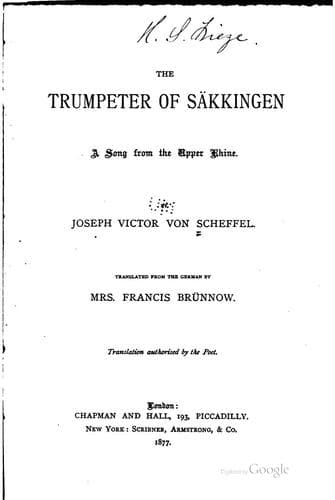
The Trumpeter of Säkkingen: A Song from the Upper Rhine.Scheffel, Joseph Victor von
General
The Trumpeter of Säkkingen: A Song from the Upper Rhine.
Scheffel, Joseph Victor von
Epic poetry, German -- Translations into English
_Page_ 5.--Amaranth, a poem by Oscar von Redwitz, published a few years
before "The Trumpeter of Saekkingen," and at that time very popular,
especially with certain classes in Germany.
_Page_ 13.--The Boezberg, a mountain in the Jura, over which the old
road from Basel to Zuerich led. Now the railroad between the two places
pierces it with a tunnel.
--The Hozzenwald, the Hauenstein mountains. See note to page 15.
--The Gallus Tower, an old tower at the upper extremity of Saekkingen,
properly called after St. Gallus, now used as a house of refuge for
homeless people.
_Page_ 14.--The graveyard of Saekkingen contains still the tombstone of
the hero and heroine of the poem. Their names, as given there, are
Franz Werner Kirchhofer and Marie Ursula von Schoenau. The first died
in May, 1690, the latter in March of the following year.
_Page_ 15.--The Eggberg is one of the mountains in the Hauenstein
country, to the north of Saekkingen. The inhabitants of this country
were formerly remarkable for their quaint costumes coming down from the
15th century. The men wore shirts with large frills around the neck,
red stomachers, long black jackets, and wide trousers reaching below
the knee, and called hozen. Hence the land was called Hozzenland. The
dress of the women was also very peculiar, and of many bright colours.
These old costumes are now rarely seen.
_Page_ 17.--"The silvery lake," a romantic small lake, half an hour
N.W. from Saekkingen. It lies in a hollow on the hills, surrounded by
rocks and splendid fir-woods. The lake, which is known by the name of
Berg See (mountain lake), is now also called Scheffel See. It is a
favourite spot for excursions from far and near, and abounds in fish.
_Page_ 19.--The Feldberg, the highest point of the Schwarzwald.
_Page_ 20.--St. Blasien, formerly a very ancient monastery of
Benedictine monks, called thus after St. Blasius, Bishop of Sebaste,
whose relics were brought here by one of the early abbots.
_Page_ 21.--"Then appeared as Death and Devil." This is the subject of
one of Albrecht Duerer's most celebrated engravings, called Ritter, Tod,
and Teufel (the Knight, Death, and the Devil), where the knight rides
quietly and unmoved through a gloomy mountain glen, smiling at Death,
who holds up an hourglass before him, and taking no notice at all of
the droll Devil, who tries to grasp him from behind. The knight is
evidently an embodiment of the freer spirit which began to reign then
in Germany. The engraving is of the year 1513.
_Page_ 26.--"Far off on the island glisten." The town of Saekkingen with
its minster.
_Page_ 30.--Rheinfeld, or rather Rheinfelden, a town on the left bank
of the Rhine, about halfway between Saekkingen and Basel, where, during
the Thirty Years' War, in the year 1638 several actions took place.
_Page_ 32.--Wehr, a village about six miles from Saekkingen, on the road
to Schopfheim, in the neighbourhood of a stalactite cave (Hasler
Hoehle) mentioned in the Tenth Part.
Public-domain text, read in full here on John Shaqi.
Reviews
Reviews
No reviews yet
Be the first to share your thoughts on this work.
Elsewhere in the archive
Join the Discussion
Join the discussion
Sign in to leave a comment or review.
Sign InorCreate an account