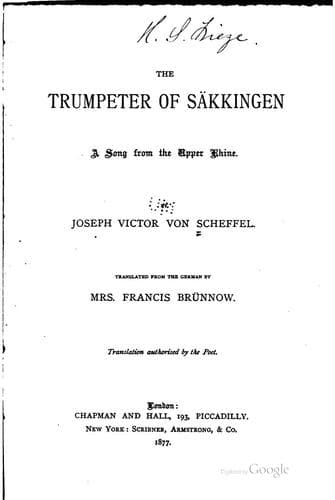
The Trumpeter of Säkkingen: A Song from the Upper Rhine.Scheffel, Joseph Victor von
General
The Trumpeter of Säkkingen: A Song from the Upper Rhine.
Scheffel, Joseph Victor von
Epic poetry, German -- Translations into English
_Page_ 56.--Count Ursus of Glarus had been converted to Christianity by
St. Fridolinus, and, with the consent of his brother Landolph, donated,
a short time before his death, all his estates to the new cloister at
Saekkingen. When Landolph, after the death of his brother refused to
acknowledge his will, Fridolinus was obliged to go to law in order to
make good his claim, and after a long litigation was at last notified
by the government of Glarus that he would not be able to have his
claims settled, unless he could bring the dead Count Ursus himself in
court as a witness. Then, the legend says, Fridolinus went, on the day
appointed for the court, to Glarus, raised Ursus from his grave, and
walked with him to Rankweil (the seat of the court, ten hours from
Glarus), where the count gave testimony in regard to his donation.
Landolph then not only gave up his brother's estates, but added also a
large portion of his own. After that Fridolinus walked back to Glarus
with Count Ursus, and committed him again to his grave. The saint, on
account of this miracle, is visually portrayed in company with the
skeleton of Count Ursus.
_Page_ 58.--Laufenburg, a town six miles above Saekkingen, and situated
on the beautiful rapids of the Rhine. A tower of the old strong castle
on the Swiss side is still standing.
_Page_ 59.--Beuggen, a town on the Rhine below Saekkingen. The ancient
building of the Teutonic order is still standing, and is used now by
the Moravians as an institute for children.
_Page_ 71.--The Wiese, a river coming from the Feldberg and flowing
into the Rhine a little below Basel. The beautiful valley of the clear
rapid river is now much visited, as there is a railroad as far as the
town of Zell. This region has become classic through the poet Hebel,
who wrote in the Allemannic idiom, still generally spoken in this whole
region. At Hausen, the station before Zell, where he was born, a
monument has been erected to him. There is also at Schopfheim,
the station below Hausen, on a hill called Hebelshoehe, a bust
of the poet The women of this region are remarkable for their large
singular-looking caps, to which Scheffel alludes.
_Page_ 76.--This gravel bank, called Field of Fridolinus, is still seen
in the Rhine, opposite the castle Schoenau.
_Page_ 80.--Hallau, a village not far from the railroad station
Neuhausen, the stopping-place for visiting the falls of the Rhine. The
red wine grown there is still very celebrated.
--The Hohe-Randen, a mountain to the north of Schapfhausen.
_Page_ 85.--Theuerdank, a German poem of the beginning of the 16th
century, written by Melchior Pfinzing, the secretary of the Emperor
Maximilian, who had planned and sketched the poem himself.
_Page_ 101.--Grenzach, the first German village going from Basel, on
the railroad to Saekkingen and Constanz. It is celebrated for the wine
grown there.
_Page_ 104.--The Frickthal, in the Swiss canton Aargau, nearly south of
Saekkingen.
Public-domain text, read in full here on John Shaqi.
Reviews
Reviews
No reviews yet
Be the first to share your thoughts on this work.
Elsewhere in the archive
Join the Discussion
Join the discussion
Sign in to leave a comment or review.
Sign InorCreate an account