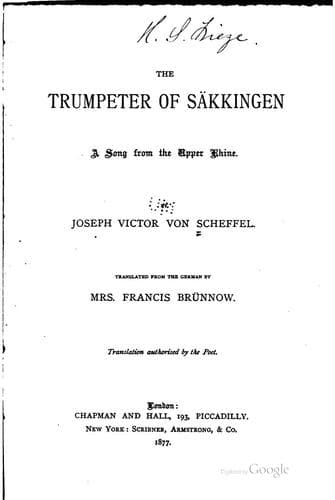
The Trumpeter of Säkkingen: A Song from the Upper Rhine.Scheffel, Joseph Victor von
General
The Trumpeter of Säkkingen: A Song from the Upper Rhine.
Scheffel, Joseph Victor von
Epic poetry, German -- Translations into English
_Page_ 169.--The ancient county of Hauenstein lies between two spurs of
the Feldberg, the eastern one coming down to the town of Waldshut on
the Rhine, the western one to Saekkingen. It is also called Hozzenland
(see note to page 15). The early history of the country is somewhat
obscure until the time of the Emperor Rudolph of Hapsburg, when it
acknowledged the sovereignty of Austria. In the times of the fight for
the German throne between Albrecht of Austria and Adolphe of Nassau,
and between Frederick the Beautiful and Ludwig of Bavaria, when Suabia
was without a duke and Germany without an emperor, the different
villages of the country founded a union (Einung) for their protection.
There is still in existence such a union document drawn up in the year
1433. The entire union was divided into eight smaller ones, each of
which stood under an elected leader (Einungsmeister). All these eight
leaders elected one of their body as speaker (Redmann), who held the
leadership of the entire union. By this the Hauenstein peasants were
greatly protected in their ancient rights; still the oppression of the
Austrian governors (Waldvoegte) often incited revolutions, the most
important of which occurred during the Peasants' War in 1525. Others
lasted from 1589 to 1614, arising from an impost laid on wine. The poet
introduces such a rising here in the course of his story.
_Page_ 206.--The Fuggers are an Augsburg family, who, by their
linen-trade and weaving, and afterwards by the purchase of mines in
Austria, amassed an enormous fortune, and were raised to the rank of
nobles by the Emperor Maximilian. The family attained their greatest
splendour under the Emperor Charles the Fifth, who, at the time of the
Diet at Augsburg, raised the two brothers then living to the rank of
counts.
_Page_ 235.--Katzenjammer, literally translated, cats' misery, the
vulgar German expression for the indisposition after a drunken debauch.
_Page_ 255.--Parcival, written by Wolfram von Eschenbach about the year
1200. Theuerdank, a German poem of the 16th century. See note to page
85.
_Page_ 277.--"As at Strasburg on the bulwarks." The Swiss soldier
refers here to a popular song:
Zu Strasburg auf der Schanz,
Da ging mein Trauern an, etc.
The simple but touching story of a soldier who stands guard on the
bulwarks of Strasburg and hears the Alpine horn blown on the other side
of the Rhine. Seized with home sickness he swims across the Rhine, but
is taken afterwards and shot as a deserter.
_Page_ 278.--The villa of the Cardinal Borghese, Casa Baldi, near
Olevano, in the Sabine country, is still in existence, and
is now an inn much frequented by artists. It has become celebrated by
Scheffel's humorous song, "Abschied von Olevano" (Farewell to Olevano),
which he wrote on the spot when leaving there after a long sojourn. It
is published in Scheffers collection of songs, "Gaudeamus."
Public-domain text, read in full here on John Shaqi.
Reviews
Reviews
No reviews yet
Be the first to share your thoughts on this work.
Elsewhere in the archive
Join the Discussion
Join the discussion
Sign in to leave a comment or review.
Sign InorCreate an account